Whitehaven’s FY26 was understandably softer as weaker coal prices through most of FY26 weighed on earnings, with revenue of A$5.40bn, EBITDA down 8% to A$1.25bn and operating cash flow down 16% to A$1.06bn, alongside a 6c final dividend. However, we think looking in the rear-view mirror misses the more interesting part of the story. FY27 guidance points to 38–41Mt of managed ROM production and 30.4–33Mt of coal sales, while new NSW and Queensland rail contracts should improve logistics costs and April’s refinancing is expected to save A$50–55m annually in interest. WHC is also returning to buybacks, with up to A$47.3m earmarked at this stage.
The FY26 earnings decline was hardly a surprise to MM, but importantly, WHC has several levers to improve returns without needing coal prices to surge. Lower financing costs, better rail economics and continued cost discipline should provide meaningful support to FY27 earnings, while buying back shares makes sense when the market continues to assign a low multiple to the group’s long-life assets.
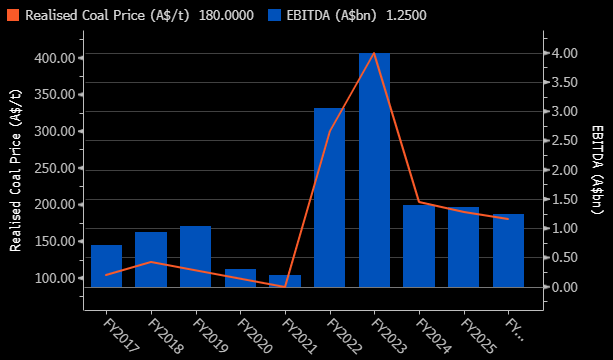
- WHC is highly leveraged to coal prices; the 10-year earnings history illustrates this perfectly, EBITDA swung from A$205m (FY2021) to A$3.99bn (FY2023) and back to A$1.25bn (FY2026), almost entirely driven by coal price cycles.
WHC offers some of the highest leverage to the coal price among ASX-listed producers. With no hedging, ~57% met coal / ~42% thermal revenue split, and significant operating leverage above its cost base (~A$135/t), a US$10/t move in either benchmark translates to a meaningful EBITDA swing — particularly in met coal given the higher realised price and larger volume base.
- To put things into perspective, if/when coal prices hit US250/MT (~5% higher) WHC’s EBITDA will lift by ~20%.
The chart below illustrates that while WHC is doing things right operationally, it’s a coal price play with a high degree of EBITDA sensitivity at current levels.
chart

Whitehaven Coal Ltd (WHC) Realised Coal Price (A$/MT) v EBITDA – Source: Bloomberg
chart
Whitehaven Coal Ltd (WHC) Realised Coal Price (A$/MT) v EBITDA – Source: Bloomberg
Whitehaven is now primarily a metallurgical coal producer by revenue, with met coal contributing around 57% following the transformational acquisition of BHP’s Blackwater and Daunia mines in 2024, although thermal coal remains slightly larger by production volume. The acquisition has strategically repositioned WHC toward higher-margin steelmaking coal, while its legacy NSW operations at Maules Creek and Narrabri continue to provide significant exposure to high-quality thermal coal.
Two years on, we still like the move by WHC to acquire BHP’s assets. Despite coal prices remaining somewhat lacklustre, the company is doing all the right things, positioned to benefit as the commodity grinds higher through 2026.
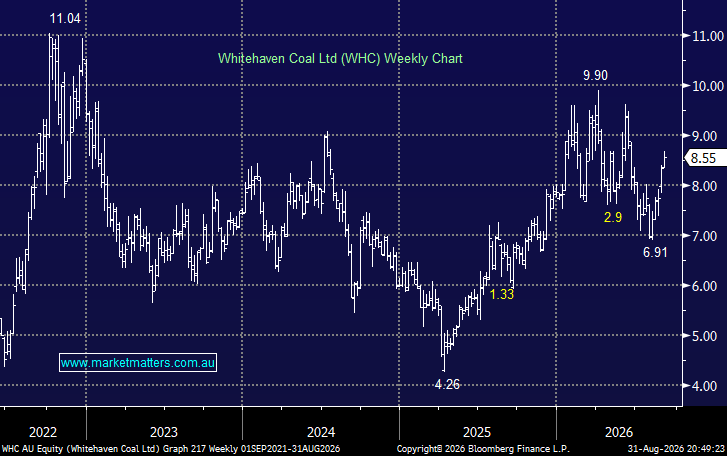
- We are targeting a break above $10 by WHC into Christmas: MM owns WHC in its Growth Portfolio.
MM is long and bullish towards WHC
Add To Hit List