We believe there’s more to Glencore’s listing on the ASX than just valuation, although that’s a bonus on a couple of fronts. We will be amazed if GLC isn’t involved in some M&A in the coming years; it’s certainly got history!
Glencore and Rio Tinto have held at least three rounds of merger discussions since 2014, culminating in their most serious attempt in January–February 2026. The proposed all-share transaction, with Rio Tinto as the acquirer, would have created a mining goliath worth approximately US$260 billion – challenging BHPs size – combining major iron ore, copper and aluminium assets with Glencore’s coal operations and global marketing/trading division. The strategic rationale centred on accelerating Rio’s copper growth through Glencore’s project pipeline, alongside the usual synergies from corporate cost savings, operational efficiencies and marketing.
However, the proposed combination also presented significant complexities, including the valuation of Glencore’s copper projects in Argentina and the Democratic Republic of Congo (DRC), its coal exposure and the integration of its trading business. The transaction ultimately collapsed in February, with valuation and governance emerging as the key sticking points. Glencore reportedly sought around 40% of the combined entity, implying a substantial premium, while the parties could not agree on an acceptable division of value, control and leadership responsibilities.
- If GLC’s shares address some of the valuation gap with RIO, perhaps it will reconsider, especially now both companies are trading on the ASX – 4th time lucky, perhaps.
Following the failed merger talks, both companies refocused on their standalone strategies. In February 2026, Glencore signed a non-binding MOU to sell a 40% stake in its DRC copper and cobalt assets to the Orion Critical Mineral Consortium, at an implied enterprise value of around US$9 billion. The proposed sale would reduce Glencore’s exposure in a challenging region. RIO, meanwhile, is prioritising organic growth, targeting 40–50% earnings (EBITDA) growth by 2030 from a 2024 baseline, while seeking to unlock US$5–10 billion through asset sales, minority stake disposals, and infrastructure transactions.
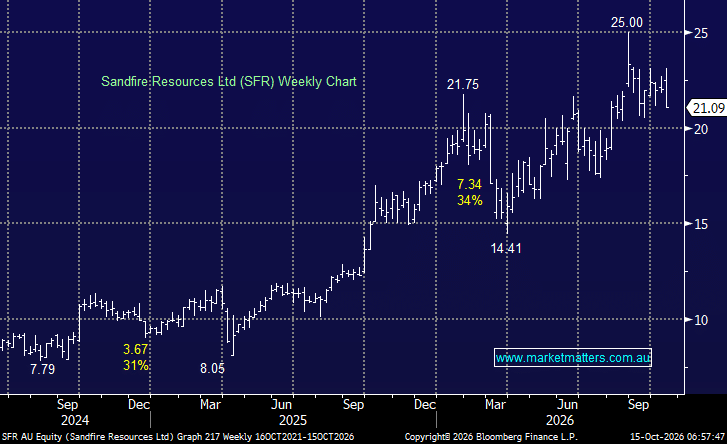
We know miners are looking to consolidate to benefit from synergies and scale; in 2024, BHP attempted to buy Anglo American with an eye firmly on its copper assets. Another M&A possibility for Glencore, which is not getting much airtime, is ~$10bn copper play Sandfire Resources (SFR):
Sandfire and Glencore have overlapping copper interests across southern Africa and the Iberian Peninsula. In Botswana, Sandfire’s Motheo Copper Mine, its key growth asset, is ramping up towards ~60,000 tonnes of annual copper production. Glencore’s Mopani Copper Mines are in neighbouring Zambia, giving the company exposure to the broader southern African copper industry, although not directly adjacent operations. The more meaningful geographic overlap is in Spain’s Iberian Pyrite Belt, where Sandfire’s MATSA complex operates three underground mines, Aguas Teñidas, Magdalena and Sotiel, producing copper, zinc and lead. Glencore also has a broader base metals trading and marketing presence in the region.
The overlap is arguably strategically relevant when considering potential industry consolidation, as Glencore’s global marketing capabilities and established base metals expertise could complement Sandfire’s producing copper assets.
- Once GLC is established on the ASX, it will be in a stronger position to pursue an ASX stock, with investors likely to be more open to cash &/or stock bids.