Hedge funds have shifted their short positions away from ASX resource names that benefited from the recent commodities boom, targeting consumer-facing stocks such as Treasury Wine Estates, Domino’s Pizza and Guzman y Gomez amid concerns around weakening household spending. Just six months ago, five of the six most shorted stocks on the ASX were resource plays, including uranium names Boss Energy and Paladin Energy, alongside lithium producers Pilbara Minerals, Liontown Resources and Mineral Resources. Today, traders have pivoted, with Domino’s Pizza now the most heavily shorted stock on the ASX, while Treasury Wine Estates and Guzman y Gomez also feature among the top five most shorted names.
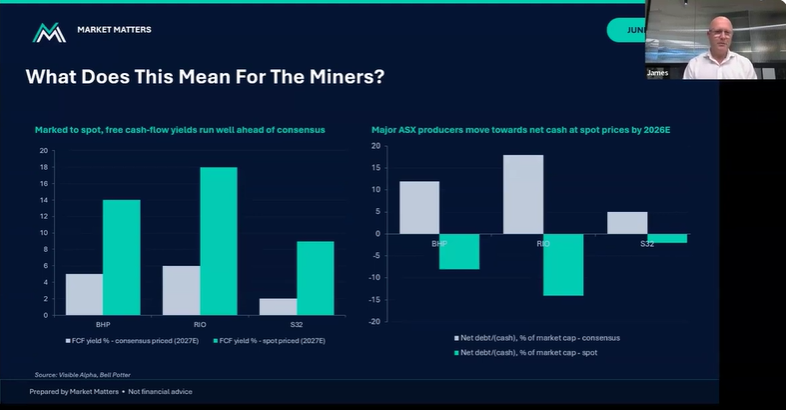
- The landscape has really changed for lithium and critical mineral miners; their balance sheets have significantly improved following the rise in commodity prices and increased demand.
The rotation reflects growing concerns around consumer demand after the RBA lifted the cash rate to 3.85% to tackle a renewed uptick in inflation, with bond markets now pricing the risk of further tightening. Rising oil prices following the Middle East conflict could add to inflationary pressures via higher petrol costs, increasing the likelihood of another rate hike and further weighing on consumer stocks.
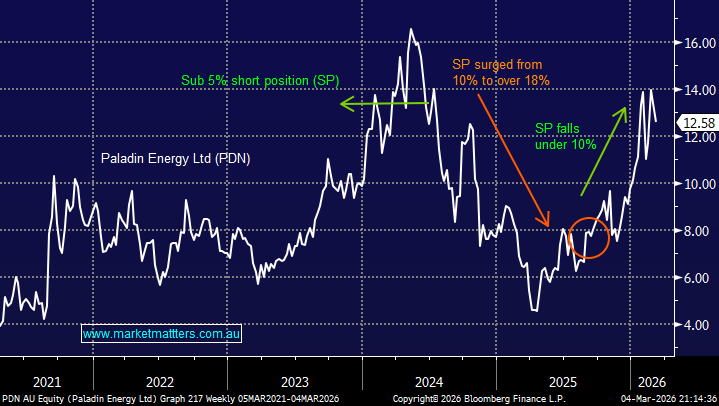
Firstly, we’ve taken a look at the progression of both Paladin (PDN) and PLS Group (PLS) as its short position both built and reduced to see if any patterns emerge:
- PDN’s short position (SP) was built aggressively from sub 5% to over 14% between July and December 2024; over this period, the stock basically halved.
- The SP hovered between 15% and 18% over the next 9-10 months while the stock traded in a volatile range between $4 and $9.
- The stock has surged ~80% since late 2025, not long after the SP decreased sharply from 18% to 11% in September last year after PDN successfully raised $300mn at $7.25.
- The SP remains reasonably high today at 9.6% even as the uranium stocks gather momentum – the 11th largest short position.
We see three takeaways from PDN’s journey:
- Don’t buy stocks when SPs are rising.
- A large SP can exist for a long time without exerting a meaningful influence on a stock. Often, this is due to traders having a pairs trade on – buying one stock in a sector and shorting another to remain net neutral.
- It’s a bullish sign when SP starts to decrease.

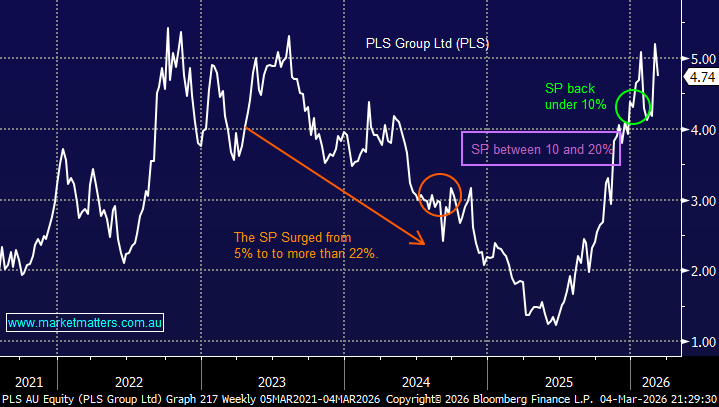
Moving onto PLS Group (PLS) to see if it delivers a similar story to PDN:
- PDN’s short position (SP) was built aggressively from sub 5% to over 20% between July and November 2023; over this period, the stock fell ~40%.
- The SP hovered over 20% through the first 9 months of 2024 while the stock basically halved again.
- The SP then oscillated between 10 and 20% through most of 2025 while the stock looked for direction between $1.50 and $2.50.
- The stock has surged five-fold from its June 2025 low but the SP didn’t start to decrease materially until September 2025.
- The SP remains reasonably high today at 7.9%, the 24th most shorted stock on the ASX.
We see three takeaways from PLS’s journey:
- Don’t buy stocks when SPs are rising.
- A large SP can exist for a long time without exerting a meaningful influence on a stock.
- It’s a bullish sign when SP starts to decrease but it’s doesn’t always pick the low.
When we combine the read through’s from PDN and PLS, not a huge sort size we acknowledge, two points standout to MM for investors considering contrarian plays:
- Don’t buy stocks when SPs are rising.
- The low point for stocks can occur during periods when the SP remains high – but is no longer rising.