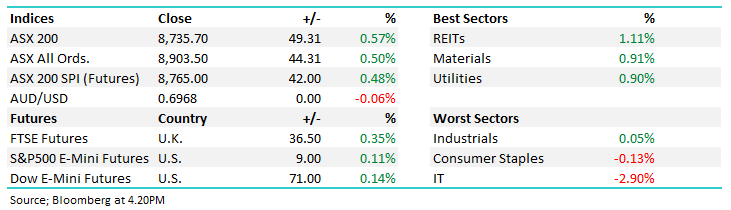
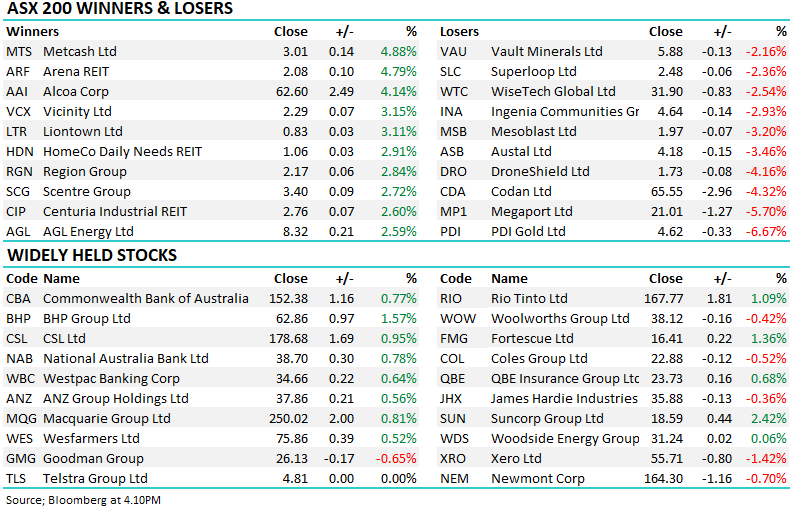
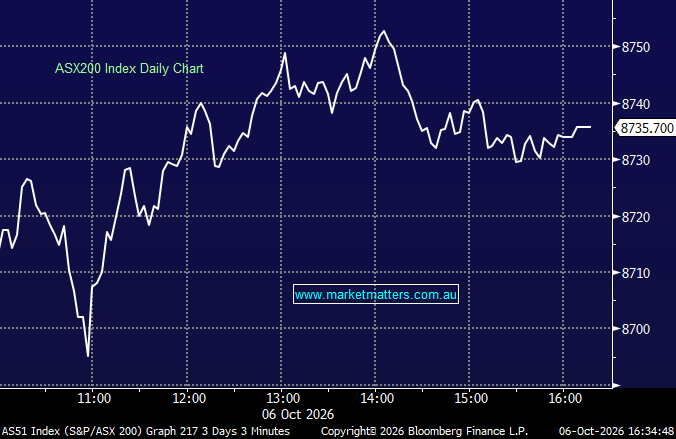
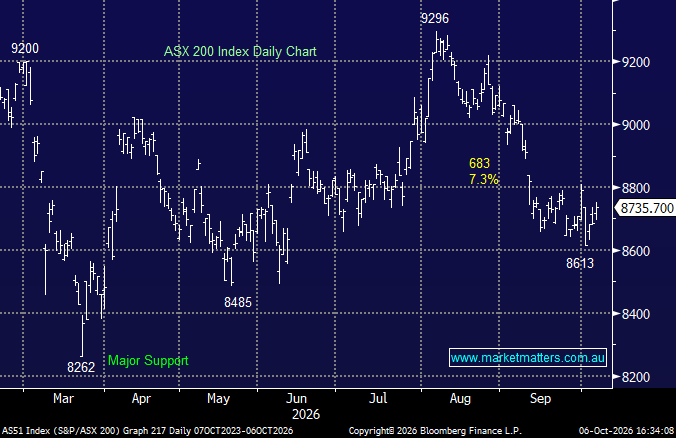
The ASX200 enjoyed broad-based buying on Thursday, pushing the index up 27 points / +0.3%; less than 30% of the main board closed lower, with healthcare as the weakest sector. BHP Group (BHP) and Medibank Private (MPL) added 9 points to the index, while CSL was the standout detractor, taking more than 7 points off the ASX200.
The ASX200 slipped another 0.1% on Wednesday, posting new six-week lows in the late morning. Losses were broad-based, with over 60% of the main board retreating, but from a points perspective, the large-cap miners did the damage, while the banks offered some rare support for February.
The ASX200 retreated -0.7% on Tuesday on broad-based selling, which saw less than 40% of the main board close higher. The defensive names dominated the “winners enclosure,” with the utilities, consumer staples, and healthcare sectors occupying three of the winner's spots that managed to eke out gains.
The ASX200 recovered from early steep losses on Monday to finish up +0.1% as the banks enjoyed some bargain hunting after last week's aggressive sell-off. The “Big Four” finished an average of +2.2% higher, led by heavyweight CBA, which finished the day up +3%.
The ASX200 retreated over 3% last week, with the driving force behind the sell-off being the previously high-flying and influential Banks. In a rare show of weakness, the “Big Four” retreated more than 10% on average as sentiment soured towards the sector.
The ASX200 fell to a 5-week low on Thursday, ultimately closing down 1.1%, extending the current pullback to 328 points / 3.8%. Losses were focused in the big end of town, with the banks again suffering after failing to satisfy lofty expectations moving into earnings season.
The ASX200 dropped another 0.7% on Wednesday with the banks accounting for 85% of the decline. The market has dropped over 200 points/2.6% since MM adopted a neutral stance last week, but we’re in no hurry to “buy the dip” just yet.
Tuesday's interest rate decision and accompanying commentary was one occasion we weren’t overly happy to be correct on; MM has written a few times recently that the RBA should and will cut rates by 0.25%, but we expected a cautious tone and only one more cut in 2025.
The ASX200 slipped -0.2% on Monday, a reasonable performance considering the weakness in the banks dragged the market down ~0.9% at its worst. More on the banks later, but their influence was evident, with weakness across the sector weighing on the broader market.
It's no secret that the RBA is expected to cut rates this week, with the futures market calling it an “87% probability.” However, the accompanying rhetoric is likely to drive local stocks in the coming weeks, especially with the market looking for two additional cuts into Christmas, taking the Cash Rate to 3.6%. Local rates have sat at a restrictive 4.35% since November 2023, and we think three cuts are likely to prove too dovish; Michele Bullock's comments on Tuesday will be a classic case of the devil being in the detail.
The ASX200 slipped another 0.1% on Wednesday, posting new six-week lows in the late morning. Losses were broad-based, with over 60% of the main board retreating, but from a points perspective, the large-cap miners did the damage, while the banks offered some rare support for February.
The ASX200 retreated -0.7% on Tuesday on broad-based selling, which saw less than 40% of the main board close higher. The defensive names dominated the “winners enclosure,” with the utilities, consumer staples, and healthcare sectors occupying three of the winner's spots that managed to eke out gains.
The ASX200 recovered from early steep losses on Monday to finish up +0.1% as the banks enjoyed some bargain hunting after last week's aggressive sell-off. The “Big Four” finished an average of +2.2% higher, led by heavyweight CBA, which finished the day up +3%.
The ASX200 retreated over 3% last week, with the driving force behind the sell-off being the previously high-flying and influential Banks. In a rare show of weakness, the “Big Four” retreated more than 10% on average as sentiment soured towards the sector.
The ASX200 fell to a 5-week low on Thursday, ultimately closing down 1.1%, extending the current pullback to 328 points / 3.8%. Losses were focused in the big end of town, with the banks again suffering after failing to satisfy lofty expectations moving into earnings season.
The ASX200 dropped another 0.7% on Wednesday with the banks accounting for 85% of the decline. The market has dropped over 200 points/2.6% since MM adopted a neutral stance last week, but we’re in no hurry to “buy the dip” just yet.
Tuesday's interest rate decision and accompanying commentary was one occasion we weren’t overly happy to be correct on; MM has written a few times recently that the RBA should and will cut rates by 0.25%, but we expected a cautious tone and only one more cut in 2025.
The ASX200 slipped -0.2% on Monday, a reasonable performance considering the weakness in the banks dragged the market down ~0.9% at its worst. More on the banks later, but their influence was evident, with weakness across the sector weighing on the broader market.
It's no secret that the RBA is expected to cut rates this week, with the futures market calling it an “87% probability.” However, the accompanying rhetoric is likely to drive local stocks in the coming weeks, especially with the market looking for two additional cuts into Christmas, taking the Cash Rate to 3.6%. Local rates have sat at a restrictive 4.35% since November 2023, and we think three cuts are likely to prove too dovish; Michele Bullock's comments on Tuesday will be a classic case of the devil being in the detail.
Check your email for an email from [email protected]
Subject: Your OTP for Account Access
This email will have a code you can use as your One Time Password for instant access
Verication email sent.
Check your email for an email from [email protected]
Subject: Your OTP for Account Access
This email will have a code you can use as your One Time Password for instant access
!
Invalid One Time Password
Please check you entered the correct info, please also note there is a 10minute time limit on the One Time Passcode
To reset your password, enter your email address
A link to create a new password will be sent to the email address you have registered to your account.
Market Matters members receive daily market reports, real-time trade alerts, full access to 5 portfolios and dynamic company data.
Choose how you'd like to proceed:
We have a range of membership options to suit your needs and budget, why not join today and get unlimited access to the premium Market Matters service.