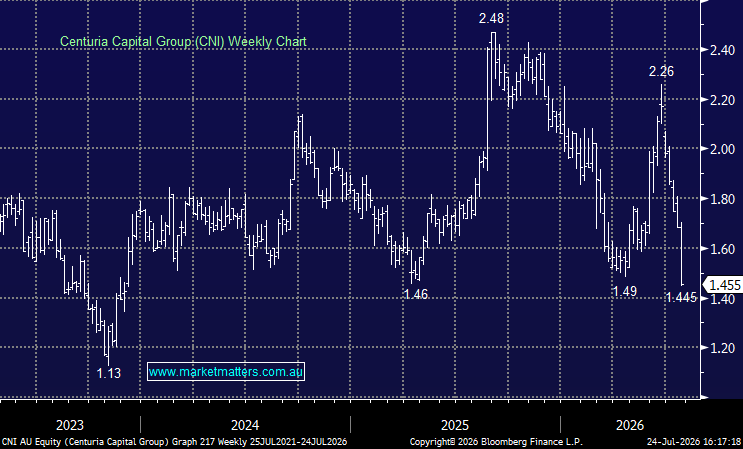
CNI – 8.01%: It’s been a terrible week for Centuria Capital (CNI), with the stock hitting a fresh 52-week low today. The sell-off has been driven primarily by a damaging private-credit controversy, amplified by the recent capital raising, with a deteriorating Australian property backdrop putting the cherry on a very sour tasting cake.
The major overhang has been the controversy surrounding the roughly $300 million Centuria Bass Credit Fund. SQM Research labelled the fund “uninvestable” this week after alleging it had breached its own lending policies through exposure to troubled Sydney apartment developer Bathla Group. CNI responded by stressing that its direct balance-sheet exposure to Bathla is limited to a separate $4.5 million loan facility and provided further detail on the fund’s exposure. However, that did little to ease the market’s concerns.
Centuria Capital owns Centuria Bass outright, having acquired an initial 50% stake in 2021, increased this to 80% in 2024 and moved to full ownership during the first half of FY26. The central allegation is that loans to Bathla breached the fund’s own limits around borrower and geographic concentration and that, rather than directly addressing the issue,
Centuria Bass subsequently amended the fund rules. Changing the rules is not necessarily unlawful, and Centuria Bass will no doubt argue the amendments were made for legitimate portfolio and liquidity-management reasons. However, the optics are poor: it looks as though the goalposts may have been moved after a large borrower ran into difficulty.
When investors entrust an organisation to manage their money, changing the rules after those funds have been committed is poor form and understandably undermines trust. The controversy has landed only weeks after CNI completed a $300m equity raising at $2/sh to fund a joint-venture acquisition (MM did not participate). While the transaction may prove strategically positive, the enlarged share base has created an ongoing dilution overhang and increased the market’s sensitivity to any deterioration in sentiment.
CNI is now trading 25% below the capital raise price.
In terms of the potential financial impact, Centuria does not disclose Centuria Bass fee revenue separately, but we estimate the business may contribute around $20–30 million of annual EBIT, equivalent to roughly 15% of group earnings. These figures are estimates, but they are likely in the ballpark.
Centuria Bass manages ~$2.5 billion, representing around 10–11% of CNI’s total funds under management. The ~$300m Centuria Bass Credit Fund which this issue relates to, itself has six loans linked to Bathla, with the broader concern being that the developer is highly leveraged and has reportedly experienced difficulties paying some staff and suppliers.
There is security in place. All fund loans are backed by first mortgages, while CNI’s direct balance-sheet exposure remains limited to the separate $4.5 million facility. However, the situation is becoming increasingly complicated and is likely to have a reputational impact on Centuria that is much harder to quantify.
In private credit, investors should always expect some loans to sour – the key protection is the underlying security: provided the secured assets can be sold for more than the outstanding loan amount, typically where lending has been capped at around 60–70% of asset value, investors should still recover their capital and accrued interest. Losses arise when the secured properties cannot be sold for enough to repay the debt.
That is why the real issue here is not yet a crystallised loss or an allegation of unlawful conduct. It is a governance and investor-treatment issue. If Centuria Bass changed the fund’s rules in a way that altered the risk profile after investors had committed capital, that is something we do not like.
At this stage, the direct financial implications appear manageable, although further issues could still emerge. The harder question is the reputational damage and what this says about governance across the broader organisation. The $300 million capital raising has added another layer of pressure.
Our inclination is that the stock has probably sold off too aggressively on the headlines, but the episode has increased our concerns about Centuria.
- We do not view this as a dip to buy and are now more likely to sell our holding in the Emerging Companies Portfolio, having already exited the stock from the Income Portfolio a few months ago.
MM has turned neutral on CNI ~$1.50
Add To Hit List