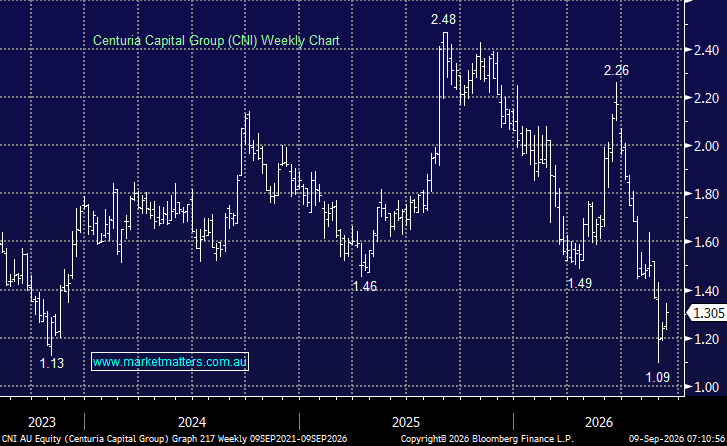
Centuria (CNI) has been under significant pressure in recent months, with the shares now trading around half their 12-month high. While the FY26 result itself was respectable, the market is increasingly focused on private credit, and specifically Centuria Bass’ exposure to the troubled Bathla Group.
First and foremost, CNI’s core real estate funds management business has not suddenly fallen apart. FY26 operating EPS rose 11% to 13.6c, AUM reached a record $22.2bn and the group completed $1.2bn of property acquisitions. However, FY27 guidance of 13.0c was around 8% below consensus, with higher interest and tax costs weighing on the outlook.
Confidence is also low because they’ve got exposure to Bathla, and that exposure increased earlier in the year when they acquired the remaining 20% of Centuria Bass Credit, taking full ownership. This is the area of the business that holds exposure to the troubled developer. From our discussions with other Private Credit managers, some of which looked at and ultimately passed on Bathla debt, the writing was on the wall at the time Centuria was upping their stake, and this move has the market on edge.
Centuria Bass has a decent exposure, estimated at around $280m across six Bathla-related projects, including two construction facilities, with the construction projects largely completed. Centuria says the loans benefit from first-ranking mortgage security and partial cross-collateralisation. Importantly, the listed CNI entity itself is not an investor in the Centuria Bass Credit Fund and has only $4.5m of direct balance-sheet exposure to a Bathla entity. The distinction is important, but it does not eliminate the problem.
Two Centuria Bass private-credit funds, with around $670m of investor capital, have suspended or restricted redemptions (gated) following elevated withdrawal requests and the deterioration in sentiment surrounding Bathla. One of the funds has also been downgraded by SQM Research. Restricting liquidity can be sensible if the alternative is being forced to sell loans or assets at distressed prices, but it is rarely good for investor confidence. Ultimately, we do have some concern around the potential for more gating of funds within the property backed private credit space, and we would certainly advocate investor caution for now.
This gets to the broader issue around private credit at present. The asset class has grown enormously during a period when investors were searching for yield, and returns have generally been very stable. The true test comes when borrowers get into trouble and investors simultaneously want their money back. Private loans are inherently illiquid, while many underlying investors expect some degree of liquidity – that mismatch becomes far more obvious when conditions deteriorate.
For CNI, this creates two separate risks. The first is credit risk – what ultimately happens to the Bathla loans and whether the first-mortgage security provides adequate protection. The second, and potentially more important for the listed share price, is franchise risk. If advisers and investors become more cautious about Centuria Bass, fund inflows could slow, redemptions could remain elevated and the growth multiple previously attached to private credit could disappear.
Interestingly, management is still forecasting Bass EBIT of around $24m in FY27, broadly unchanged from FY26, despite the Bathla issues. UBS for one is taking management broadly at face value in its forecasts, but acknowledges that a clear resolution of the Bathla exposure will be needed before investors are likely to regain confidence.
UBS think the recent sell-off has created obvious value. At $1.19 when UBS published its most recent note, CNI was trading on roughly 9x FY27 earnings, estimating the shares were around 32% below NAV and even below what it considers the conservative value of CNI’s core business excluding meaningful value for Bass and ResetData. The Swiss bank retains a Buy rating, although it cut its price target from $2.11 to $1.80 to reflect the higher risk.
Our portfolio positioning has reflected the changing risk profile. We sold CNI from the Income Portfolio in early May, before the Bathla problems emerged, because we felt the overall risk was becoming less appropriate for that strategy. We retained the position in the higher-risk Emerging Companies Portfolio, where we have greater tolerance for volatility and where the potential upside from a recovery remains relevant.
At current prices, we think a lot of bad news is already reflected. However, cheap stocks can remain cheap when confidence is damaged, and CNI now needs to demonstrate that the Bathla loans are adequately secured, work through the redemption backlog in its credit funds and show that Centuria Bass can continue attracting capital once the dust settles. The turnaround could take some time.
The underlying property platform remains valuable and the balance sheet exposure to Bathla at the listed CNI level is small, but it’s hard to quantify what reputational damage has been done from this episode, and how that will impact wider flows into Centuria funds.
- For now, we think that discount deserves to be larger than it was six months ago, but after the extent of the sell-off, there is value here, it’s just hard to put a number on it, which is likely to keep the stock under pressure while all this gets worked through.
MM is cautiously bullish CNI ~$1.30
Add To Hit List