Goodman Group (GMG) struggled early on Tuesday following the withdrawal of Project Mars, its proposed A$1.2bn, 24-hour AI data centre on Sydney’s north shore. GMG said there has been a significant evolution in the regulatory environment since planning began in March 2025, following sustained community opposition and changes to government policy around large-scale data centres (DCs). The decision removes a meaningful project from GMG’s development pipeline and adds another layer of uncertainty around the pace of its Australian AI infrastructure rollout.
- DCs are going to become a bit like apartment blocks; everyone knows that Australia needs more housing, they just don’t want it near them!
Tuesday’s weakness comes on top of a broader rate-driven derating, with GMG down around 20% over three months as surging global bond yields pressure long-duration growth stocks. Importantly, this remains a valuation rather than earnings problem: forward EPS estimates have risen around 72% over the past year, yet GMG’s forward P/E has compressed from roughly 24x to 17x. Rising yields are simply overwhelming strong earnings growth, although the added risk following Project Mars is that regulatory constraints on data-centre development eventually start weighing on the earnings outlook as well.
GMG raised A$4bn in February 2025, its first equity raise in 12 years, at A$33.50, with the deal reportedly covered multiple times within hours – doesn’t look too exciting today. MM re-entered GMG post-the raise but, in hindsight, we should have been more patient. As of its FY26 results, GMG was sitting on more than A$4bn in cash as it evolves its A$19.7 billion work-in-progress pipeline, which is ~80% DC-focused – Project Mars was reported to have a cost of A$1.2 billion.
- No other GMG site in Australia appears to face an imminent community or regulatory roadblock; the greater risk is systemic, with a rapidly evolving planning and regulatory environment across NSW and Victoria potentially complicating future approvals across its data-centre pipeline.
Building a data centre in Australia is moderately onerous. It’s easier than power-constrained Europe or Singapore, harder than the best US states, but the rules have become stricter since August. Operators must now fund their own grid upgrades, buy renewable certificates to match their consumption and cut water use. This raises both the cost and complexity of bringing new capacity online, particularly around Sydney, where electricity infrastructure is already becoming constrained as data-centre demand grows.
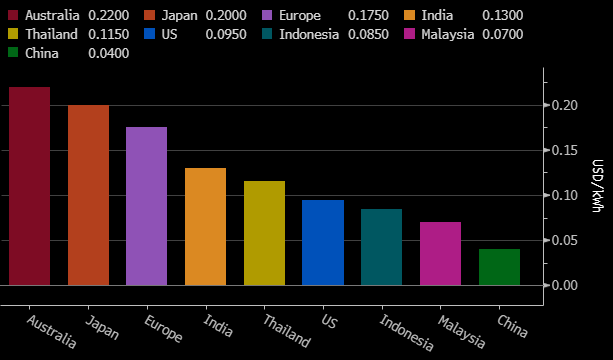
Australia is a high-cost market on power but mid-range on construction, meaning the structural disadvantage compounds over the operating life of a facility, where electricity is the dominant cost driver (up to 70% of opex). Southeast Asia (Indonesia, Malaysia) offers the best combined profile for new AI data centre development.
Fortunately, Goodman’s DC growth story is overwhelmingly offshore, with around 90% of development revenue generated outside Australia. Momentum remains strong across its global pipeline, including a 20-year hyperscaler lease for the first 50MW of its 1GW Tsukuba campus in Japan, fresh institutional capital for Hong Kong, a A$2.6bn European commitment with CPP Investments, and a A$1bn DataBank deal in Los Angeles. Against this backdrop, the withdrawal of Sydney’s A$1.2bn Project Mars highlights growing domestic regulatory and community resistance, however it will have limited impact on the broader pipeline and near-term earnings.
- We believe planning and infrastructure constraints warrant watching; the immediate financial impact appears limited given the global breadth of GMG’s DC strategy.
The Financial Review (AFR) reported that Data centre investment was responsible for Australia’s entire economic growth in Q1 2026 (March quarter GDP: +0.3%); the regulators need to be careful not to implement too many hurdles for this growth engine.
chart

Data Centre Electricity Costs by Market (US$/kwh) – Source: Bloomberg
chart
Data Centre Electricity Costs by Market (US$/kwh) – Source: Bloomberg
Australia is not a low-cost data-centre market, with electricity prices of around US$0.22/kWh roughly double US levels and 70–80% above parts of Southeast Asia, although construction costs remain relatively competitive. The offset is strong demand, with an estimated 1.0–1.5GW of active tenant requirements, while grid connection delays are generally less severe than the lengthy queues emerging in parts of the US and Europe. For Goodman (GMG), this makes its existing land, infrastructure and secured power increasingly valuable, but higher electricity costs, grid constraints and tighter regulation raise the hurdle for new developments.
- GMG is trading at a ~20% discount to its long-term valuation, affording some insulation from bond yields and uncertainties around future DC earnings.
Digital Realty (DLR US) provides a second useful comparison and arguably represents where GMG is ultimately heading — a large-scale, global data-centre platform servicing hyperscalers and other major technology customers. DLR has a market capitalisation of around US$67bn and trades at a substantial valuation premium, reflecting the earnings visibility attached to established data-centre assets and long-term customer contracts. The important distinction is that DLR is primarily an owner/operator, while Goodman remains predominantly a developer, using its landbank and development expertise to build facilities for major customers – if GMG gets the DC evolution right and it starts locking in attractive leases, the returns should follow.
Goodman’s ~9.1% yield on recent fully fitted data-centre developments remains attractive, although below Digital Realty’s (DLR US) ~11.5%. The difference partly reflects GMG’s focus on long-term hyperscaler projects, which provide greater earnings certainty but generally come with lower initial returns, while DLR is benefiting from tight US capacity and stronger pricing. Importantly, completed data centres can trade at yields of only ~5–6.5%, meaning GMG is still earning a healthy premium for developing the assets itself—although higher financing costs are narrowing that margin and making pre-leasing at attractive rents increasingly important.
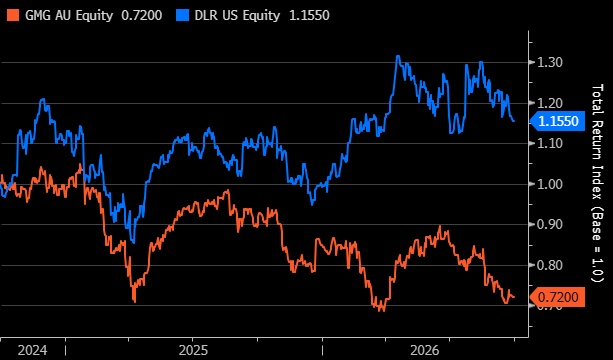
Unfortunately, this tells another tale of the ASX struggling in 2026, with DLR (+16%) comfortably outperforming GMG (-15%). DLR has benefited from repeated earnings beats, significant capital deployment and a credit upgrade, while GMG has suffered a sharp valuation derating despite strong earnings growth, as surging long-term bond yields and emerging regulatory headwinds in Australia have weighed on its premium valuation.
- We like the risk/reward towards GMG around $26 and own the stock in our Growth Portfolio.
MM is bullish towards GMG around $26
Add To Hit List
chart
Goodman Group (GMG) vs. Digital Realty (DLR) – Source: Bloomberg
chart
Goodman Group (GMG) vs. Digital Realty (DLR) – Source: Bloomberg