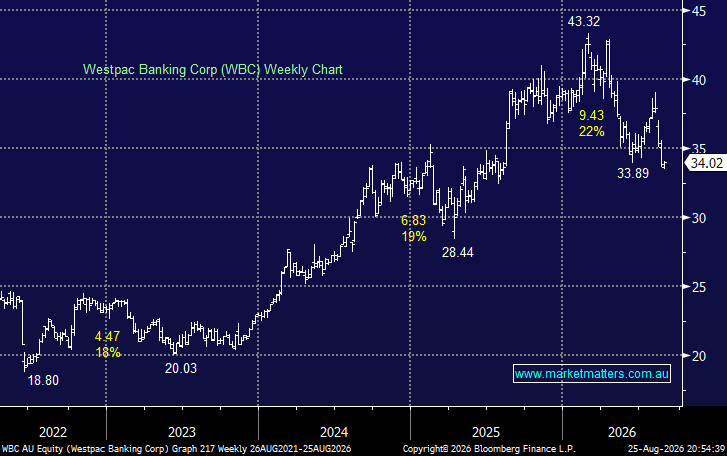
Westpac has now fallen ~20% from its recent highs as sentiment towards the banks has deteriorated sharply. The trigger has been a sudden slowdown in lending activity, particularly mortgages, with application volumes dropping materially across the majors. The market’s concern is straightforward: if credit growth slows sharply, revenue momentum follows, while costs and investment spend remain sticky.
The question for MM is whether this is simply a pause in the cycle, or the start of a more prolonged earnings slowdown. For an income portfolio, the second question is equally important: has the pullback now created enough valuation and yield support to compensate for the weaker near-term growth outlook?
We have been very lightly exposed to bank equity in the Income Portfolio. ANZ is our only current holding and has been the best-performing major bank over the past 12 months, while we sold Commonwealth Bank in July 2025 at ~$180. That positioning has served us well, but the recent correction has us running the ruler over the sector for income opportunities, and Westpac is one we are now considering.
The near-term operating backdrop is clearly softer. Mortgage application volumes have fallen sharply since the May Federal Budget, with Westpac applications down around 20%, including owner-occupier applications down roughly 18% and investor applications around 26% lower. That weakness is not isolated to Westpac and has become a sector issue, which is why the banks have been sold aggressively. WBC has been less keen to discount relative to the others, and has therefore experienced a greater hit to volumes, however, that should be more supportive of margins.
The key uncertainty is how long this slowdown lasts. Housing credit demand is cyclical and can recover quickly if confidence improves, interest-rate expectations stabilise and housing turnover picks up. However, there is likely to be a lag between better conditions and a meaningful recovery in bank earnings, particularly while competition for deposits and mortgages remains intense.
Importantly, Westpac’s investment case is more about excess capital than growth.
As we wrote earlier this month (here), the bank has a significant amount of excess capital available for distribution. Westpac’s CET1 ratio was 12.75% at the end of March (reported at their 1H26 results in May), implying around $2.7bn of surplus capital above its internal target. The subsequent sale of the $15.4bn RAMS mortgage portfolio added another 23 basis points to CET1, equivalent to more than $1bn of additional capital headroom.
Westpac also has approximately $3.7bn of surplus franking credits, the largest balance among the major banks. That creates a strong incentive to return capital through fully franked dividends rather than relying exclusively on buybacks.
The capital-management setup looks attractive:
- Around $2.7bn of pre-existing surplus capital.
- More than $1bn of additional capital released through the RAMS portfolio sale.
- Approximately $3.7bn of surplus franking credits.
- Potential for a 20–40c special dividend at the November result, although Westpac has provided no formal guidance.
A special dividend is certainly not guaranteed. Westpac was also in a strong capital position last year and elected not to pay one, while elevated investment spending through the UNITE program remains a drag on earnings. Credit costs are also likely to normalise higher from unusually low levels.
Following the pullback, the yield support is becoming more attractive, and the potential special dividend becomes more meaningful. If consensus is correct, and WBC pay 80cps in November, plus a 30c special (mid-point of potential), a $1.10 dividend equates to 3.2% for the half fully franked, or 4.6% gross. If they keep the 80cps in May 2027, the 12-month yield is worth ~8% (incl franking).
There is also more to the earnings story than mortgages. UBS upgraded Westpac to Buy earlier this month with a $45 price target, following the RAMS sale. While excess capital was part of the reasoning, UBS also highlighted the growth outlook within Institutional Banking as an important driver of the upgrade.
We are becoming more interested in WBC for the MM Income Portfolio following the recent correction. We do not think the earnings outlook has suddenly become exciting – lending momentum has weakened substantially and it may take a few quarters before volumes recover meaningfully. But a 20% pullback has taken some of the valuation excess out of the stock, while the capital position and potential for a special dividend remain firmly intact.
- For an income focussed strategy, the combination of ordinary dividends, excess capital, franking credits and a more reasonable valuation we think now looks interesting.
MM believes WBC is a good income opportunity ~$34
Add To Hit List