Macquarie Group (ASX: MQG) has two direct links to Anthropic’s proposed IPO: Macquarie Asset Management has partnered with Singapore’s GIC to develop data centres for the Claude developer, initially targeting the US, while Macquarie Capital is among the underwriters of Anthropic’s public offering. These relationships provide Macquarie with exposure to Anthropic through both infrastructure investment and investment banking. While neither guarantees an immediate earnings boost, the IPO could raise the profile of Macquarie’s AI infrastructure investments and create additional fee opportunities – net positives but not re-rating stuff.
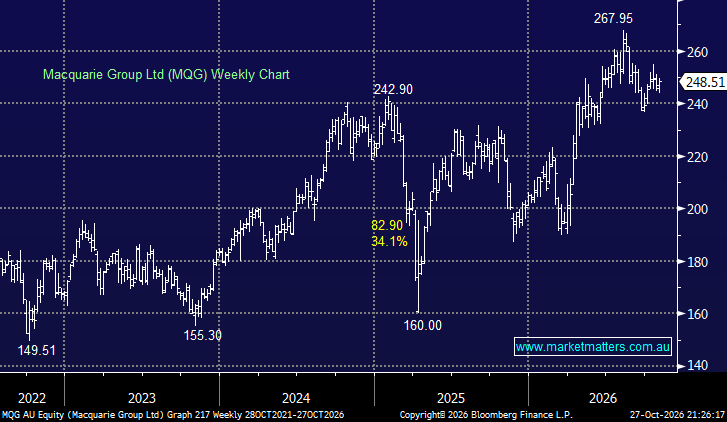
Year-to-date, MQG has advanced +22%, trumping the “Big Four”, where ANZ has been the standout and is only up +10%. MM has been comfortable holding an underweight stance towards the banks through 2026, which, as a group, have struggled to tread water, but as we touched on in recent reports, we are bullish toward ANZ and Westpac, raising the question of how top performer MQG looks from here.
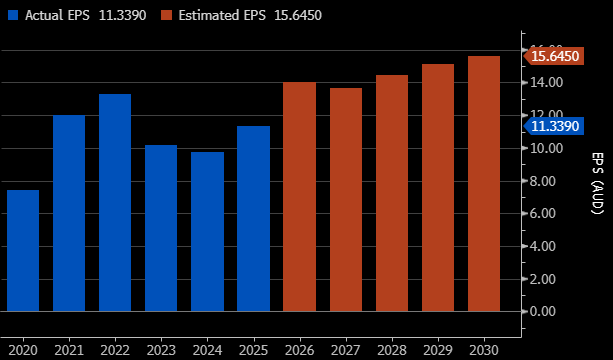
Macquarie has made a solid start to FY27 and is expected to deliver earnings growth for the year, with consensus EPS forecasts shown in the chart below. As always, earnings remain difficult to predict quarter-to-quarter, given volatility in Commodities and Global Markets (CGM) trading income and the timing of asset sales across MAM and Macquarie Capital.
Looking further ahead, consensus forecasts revenue increasing from $17.3bn in FY25 to ~$22.9bn in FY30, growth of ~30%, while EPS is expected to rise by more than 50% over the same period. These are attractive numbers, but a lot can happen over five years, and we’d be reluctant to place too much weight on forecasts that far out.
When assessing MQG, it’s worth highlighting the key businesses and themes driving underlying earnings:
- Macquarie Asset Management (MAM): A key structural growth driver, with private-markets fees forecast to grow by ~10% annually through FY30, supported by FUM growth, performance fees and capital redeployment.
- Green Energy & Infrastructure: A ~$30bn green investment portfolio, alongside growing demand for energy security, renewables and infrastructure, provides opportunities to expand fee income and recycle capital.
- Commodities & Global Markets (CGM): Accounting for ~41% of group revenue, CGM remains the biggest earnings swing factor, with results influenced by commodity volatility, client hedging and trading activity.
- Banking & Financial Services (BFS): Provides a steadier earnings stream through mortgages, deposits and business banking, although competition, funding costs and disciplined capital allocation remain important.
- Macquarie Capital: A recovery in M&A, capital markets activity and asset realisations could lift FY27 earnings, although transaction timing remains difficult to forecast.
- Digital Infrastructure & AI: Growing investment in data centres, power infrastructure and AI-related assets provides another longer-term growth opportunity, leveraging Macquarie’s infrastructure investment and financing capabilities.
We like MQG’s various levers to deliver ongoing growth, as Shemara Wikramanayake hands over the reins next month to Greg Ward.
chart

Macquarie Group (MQG) EPS History & Estimates – Source: Bloomberg
chart
Macquarie Group (MQG) EPS History & Estimates – Source: Bloomberg
From a valuation perspective, Macquarie trades at a meaningful premium to its global peers, on a forward P/E of 18.3x compared with 12.2x for Goldman Sachs, 13.5x for Morgan Stanley and 11.3x for UBS. Its price-to-book ratio of 2.6x, however, is broadly in line with Goldman (2.4x) and Morgan Stanley (2.7x). MQG’s return on equity (ROE) of ~14% also trails Goldman Sachs at 19.4% and Morgan Stanley at 19.2%. We’re not exactly comparing apples with apples, but there is clearly scope for MQG to improve its returns, which will no doubt be an area of focus for the incoming CEO.
There are valid reasons for Macquarie’s valuation premium. We expect it to deliver stronger earnings growth than many of its larger global rivals, while it also commands a scarcity premium as Australia’s only major homegrown global investment bank. Its differentiated private-markets, infrastructure and commodities businesses add to the attraction.
On balance, we think MQG’s valuation is “okay”. At current levels, it’s difficult to see much further expansion in its earnings multiple, suggesting share price gains from here will need to be driven primarily by earnings growth. Conversely, if that growth fails to materialise, any disappointment could be compounded by a contraction in the P/E multiple.
- We like MQG as a business, but its valuation isn’t compelling around $250
MM is cautiously bullish towards MQG below $250
Add To Hit List