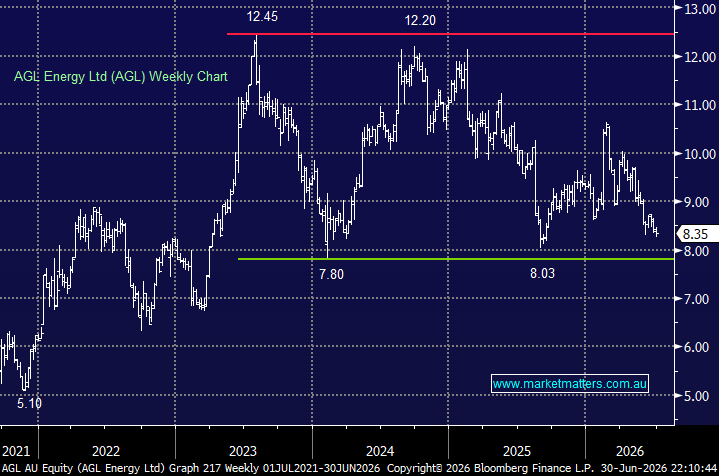
AGL has been a soft performer over recent months, despite the company actually tightening FY26 guidance in a positive direction. We own AGL in the Income Portfolio, having bought the stock in February 2023, and while the recent share price weakness is frustrating, we think it needs to be viewed through the lens of what the market is now pricing in for FY27, rather than what the business is delivering in FY26.
In May, AGL lifted the bottom end of its FY26 guidance, with underlying NPAT expected to be $610–680m, up from the prior $580–680m range, helped by improved plant availability, better retail conditions and ongoing cost discipline. However, the market looked through the near-term upgrade and focused instead on the company’s comments that FY27 guidance, due with the August result, is likely to reflect lower wholesale prices in some locations and potentially softer market conditions.
That seems to have been the catalyst to see shares sold off. AGL’s earnings have benefited from a period of elevated electricity prices, volatility and improved operational performance, but the market is now asking whether FY26 represents close to cyclical peak earnings. Lower wholesale prices, reduced volatility and regulatory pressure around household energy affordability all weigh on that debate. The AER’s final Default Market Offer for 2026–27 pointed to electricity price decreases across NSW, south-east Queensland and South Australia, which reinforces the perception that retail and wholesale tailwinds are moderating.
The other factor is capital intensity. AGL is making sensible investments to reposition the business for the energy transition, including batteries and flexible generation, but that requires capital. Last year, the company flagged pressure from rising operating and finance costs, lower wholesale prices, retail margin pressure and the decision not to fully pass costs through to customers, while also reducing its final dividend.
This is important when we think about AGL as an income stock. We bought AGL at $7.50 when sentiment was poor, the yield was attractive, and the market was overly pessimistic on the earnings base. That trade has worked very well initially; however, the market has cooled on the stock in recent months, prompting the question of whether or not we should hold or fold.
- The stock is no longer being re-rated from distressed levels; it is being assessed on the sustainability of earnings, dividends and free cash flow through the next stage of the cycle.
AGL has not suddenly become a bad business, and operational execution has improved. However, the share price weakness reflects a market that is increasingly questioning the sustainability of FY26 earnings into FY27 as wholesale prices soften and transition-related investment remains elevated.
For now, we are comfortable continuing to hold AGL in the Income Portfolio, supported by our low entry price, dividend income and still-reasonable valuation, but we acknowledge the easy money from the recovery phase has likely been made. The August result and FY27 guidance will be important in determining whether AGL remains a reliable income holding or whether the earnings cycle is starting to turn against it – until then, we’ll sit pat.
MM is cautiously bullish AGL for Income
Add To Hit List