Most pundits are blaming Trump 2.0 and the accompanying uncertainty that tariffs entail for the reason that many global indices have corrected from their recent highs; for example, the ASX 200 has fallen 10.2%, and the US S&P 500 has fallen 10.5%.
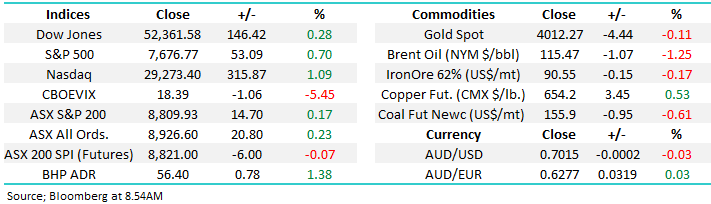
The ASX remained under pressure today, as the index notched its third consecutive day of losses, weighed down by renewed fears around the Iran conflict after reports of Iranian gunboats firing on commercial vessels and seizing ships in the Strait of Hormuz.
The ASX200 fell sharply on Wednesday, dragged lower by healthcare and banking stocks, while miners offered little support to offset the weakness. The bears dominated the company news, with Cochlear (ASX:COH) -41%, Generation Development (ASX:GDG) -23%, and Bank of Queensland (ASX:BOQ) -9.1% pushing a bounce by Treasury Wine (ASX:TWE) +17% into the shade. The ongoing weakness in the banking sector, combined with heavy selling in healthcare stocks, accounted for more than 95% of the day's decline, underscoring the market's concentration of weakness. Similarly, the trifecta of Commonwealth Bank (ASX:CBA), Cochlear (ASX:COH) and CSL Ltd (ASX:CSL) made up 50% of the day's decline on their own.
The ASX endured a tough session with heavy selling in Financials and Healthcare on a read-through from Bank of Queensland’s shrinking net interest margins and a brutal downgrade from Cochlear. The weakness came despite relatively stable overseas leads after US President Donald Trump announced a ceasefire extension – pushing US Futures higher during our time zone. However, with no deadline in play, the question becomes how long negotiations will be drawn out for, with higher oil prices incrementally adding to inflationary pressures each day that passes.
The ASX200 finished a choppy session little changed on Tuesday, for a third straight session, amid a looming US-Iran ceasefire deadline and continued tensions over control of the Strait of Hormuz. Overall, it was a quiet session on both the stock and sector front with only the consumer staples (+0.76%) and energy sector (-0.9%) moving by more than 0.5%, with the index remaining range-bound between 8890 and 9020 for the 10th consecutive session.
The ASX traded in a choppy, rotational session today with the market remaining in limbo, waiting for more news on a deal between the US and Iran. Rather than a broad risk-off move, the local bourse largely shuffled capital between sectors as traders repositioned portfolios for what a “post-conflict” environment might look like, with some recent winners - financials and energy seeing profit-taking, while technology attracted renewed buying.
The ASX200 clawed back early losses to finish marginally higher on Monday, up just 0.1%, after the Strait of Hormuz was effectively shut again almost as quickly as it had reopened. Another session where the market held its ground despite the weekend's escalation in Gulf tensions, and another reminder that investors have largely stopped reacting to each new headline with fresh conviction. The net result was more of the same: headline fatigue is well and truly setting in.
SPI Futures were pricing a rise today of +82pts following strength in the US on Friday night, however the weekend news flow was anything but positive, with the Strait of Hormuz closing just as quickly as it opened. Oil prices spiked ~8% first up this morning, Gold fell ~$US40, US Futures traded down ~0.7% and Australian equities opened flat – which is where they closed – not a bad effort considering.
Friday delivered a textbook geopolitical whipsaw. The S&P 500 and Nasdaq 100 surged to fresh record highs, and crude oil sold off sharply after Iran's Foreign Minister declared the Strait of Hormuz fully open for commercial traffic — markets breathed, algos bought, and risk was back on.
The ASX200 finished the week down -0.2%, snapping a 3-week winning streak as it failed to embrace the strength across global indices. A +13% surge by the tech sector wasn't enough to offset losses by the influential banks, with the financial sector ending the week down -2.1%. Westpac set the tone early in the week, flagging that interest-rate volatility tied to the Iran conflict had hit its market’s income and prompted higher credit provisions. While not unexpected given rising rates, cost-of-living pressures and higher fuel prices, the update reinforced a cautious “if in doubt, get out” stance from investors ahead of May results from ANZ, NAB and Westpac
Check your email for an email from [email protected]
Subject: Your OTP for Account Access
This email will have a code you can use as your One Time Password for instant access
Verication email sent.
Check your email for an email from [email protected]
Subject: Your OTP for Account Access
This email will have a code you can use as your One Time Password for instant access
!
Invalid One Time Password
Please check you entered the correct info, please also note there is a 10minute time limit on the One Time Passcode
To reset your password, enter your email address
A link to create a new password will be sent to the email address you have registered to your account.
Market Matters members receive daily market reports, real-time trade alerts, full access to 5 portfolios and dynamic company data.
Choose how you'd like to proceed:
We have a range of membership options to suit your needs and budget, why not join today and get unlimited access to the premium Market Matters service.