A lot of the market’s attention around AI has understandably focused on the companies being disrupted by it. Telstra sits on the other side of that equation. It is not trying to win the AI arms race; instead, it has one of the largest opportunities on the ASX to use AI to lower the cost of running an enormous customer base and a highly complex national network. For a business where revenue growth is likely to remain fairly modest, that matters: incremental productivity gains can flow disproportionately into margins, cash flow and ultimately dividends.
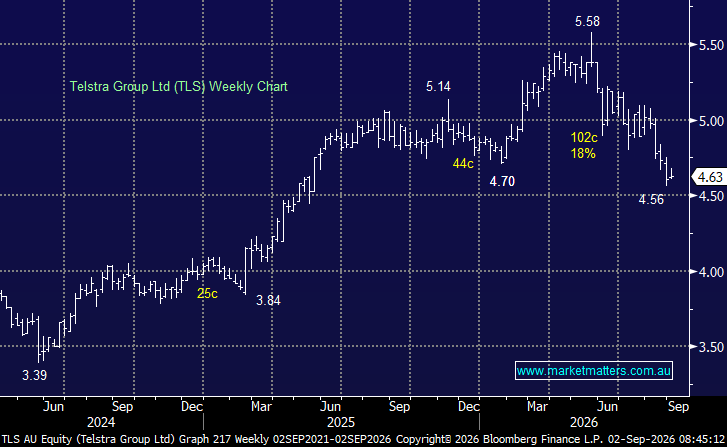
That is particularly relevant after the recent pullback. Following Telstra’s FY26 result in August, we said we would become more interested around $4.50. The stock has now fallen to around $4.60, which brings it back into the range where we think the defensive characteristics, improving earnings profile and income proposition start to outweigh some of the concerns that had us cautious earlier in the year.
The FY26 result itself was steady rather than spectacular. NPAT rose 3.2% to $2.24bn and underlying EBITDAaL increased 4%, while Telstra lifted the dividend and announced another $1bn buyback. The disappointment was FY27 cash EBIT guidance and softer postpaid mobile momentum, both of which have subsequently been reflected in the share price. there are reasonable grounds to think FY27 earnings are achievable. Telstra needs roughly $300m of EBITDA growth to deliver on guidance, with mobile expected to contribute around $300-350m alone. Slower postpaid growth should be partly offset by prepaid and wholesale revenue, while several FY26 cost items also roll off, including $206m of redundancy expenses versus a more normal $80-100m run-rate. That combination makes the earnings hurdle look considerably less demanding than the initial market reaction suggested.
This is also where the AI angle becomes more than just a thematic overlay. Telstra has already spent years simplifying the business through T22 and T25; the next productivity leg increasingly comes from automation rather than another blunt round of restructuring. AI across customer service, network monitoring, fault detection and administrative functions provides a credible way to keep reducing the cost base even if top-line growth stays subdued.
One risk with Telstra we highlighted in June was satellite connectivity after the SpaceX IPO brought further attention to their Starlink business. Telstra’s premium has historically rested partly on the breadth and quality of its network, particularly outside metropolitan Australia, so technology that fills regional blackspots naturally challenges part of that proposition. That risk is real, but we think the market is overstating it.
Telstra’s decision to incorporate Starlink into the customer proposition arguably turns some of the disruption risk into another feature of the Telstra service. The current Starlink-enabled service requires users to be outdoors with a clear view of the sky, can be intermittent, and is restricted to low-bandwidth uses such as messaging, navigation and weather. It doesn’t currently provide normal full-speed internet, traditional voice calling, streaming, large downloads or other applications requiring low latency and continuous connectivity. A mass-migration to a satellite offering such as Starlink in city areas also isn’t currently viable given urban density disrupts connectivity, as well as bandwidth limitations.
chart

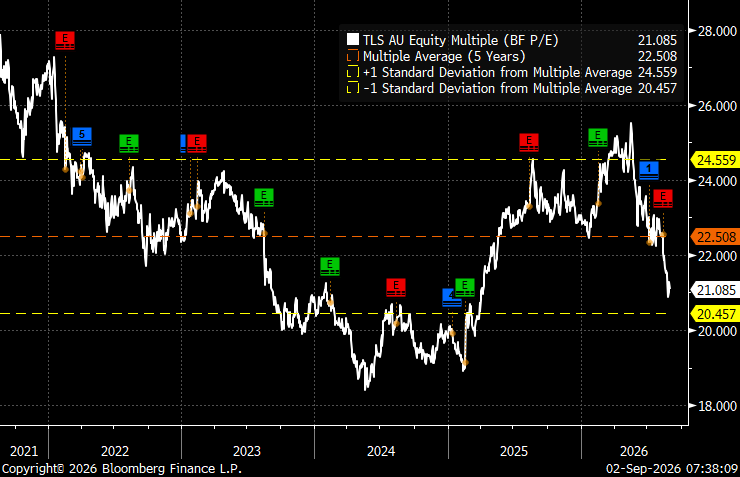
Telstra Group Ltd (TLS) Valuation (P/E) – Source: Bloomberg
chart
Telstra Group Ltd (TLS) Valuation (P/E) – Source: Bloomberg
The stock is not without challenges, but the market appears increasingly focused on disruption risks while potentially underestimating the offsets: AI-led productivity, improving operating leverage, infrastructure demand, a broader mobile portfolio and the ability to turn satellite connectivity into part of Telstra’s own offering.
- Consensus has dividends rising from 21c in FY26 to 22c in FY27, 23c in FY28 and 24c in FY29, implying a prospective FY27 cash yield of roughly 4.8% at today’s share price, before franking.
TLS is now trading back toward -1 standard deviation from its multiple average – on the ‘cheap’ side. Given its valuation, a dependable and growing dividend, further buybacks and defensive earnings; it’s starting to look attractive again.
MM is starting to get interested in TLS
Add To Hit List