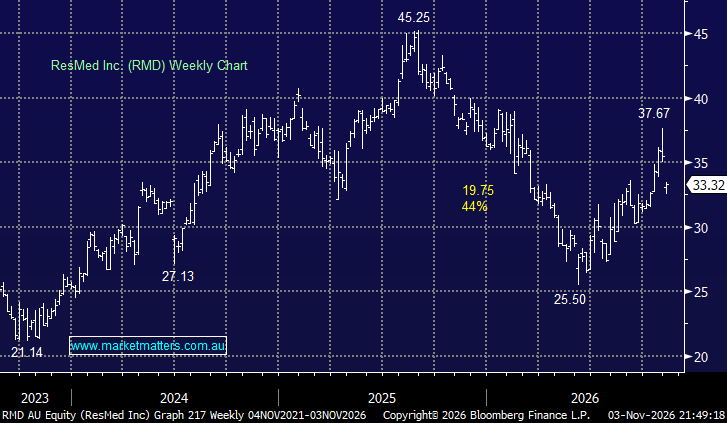
ResMed (RMD) has struggled this week, closing yesterday almost 12% below last week’s high following a poorly received 1Q27 result which was again all about guidance:
- Revenue of $1.42bn, up 5.9% YoY, beat $1.39bn forecasts, while Adjusted EPS of $2.91 beat the $2.68 estimate by an impressive ~9%, representing 14% growth versus the prior-year period.
- Gross margins expanded 50 basis points to 62.5%, well ahead of the 61.8% consensus estimate and guidance, driven by productivity execution.
- RMD maintained FY27 guidance of $5.75–$5.85 billion in revenue and EPS of $12.00–$12.25.
The numbers look impressive on the surface, but the market had been looking for, and importantly priced in, an upgrade to FY27 guidance, leading to a couple of post-earnings downgrades. However, while the 2 analyst downgrades were far from aggressive into a market that was long having taken the stock up almost 50% from its 2026 low, they were enough to cause a relatively sharp downward rerating of the stock.
- Overall, MM thought this was a strong and clean result from ResMed. The core business continues to perform well, margins are holding up, and demand remains robust.
The question we consider this morning is whether RMD’s earnings deserve it to be trading ~30% below its 5-year average valuation. The chart below illustrates how RMD has delivered strong revenue and earnings growth since COVID, and is expected to do so into 2030, while PE compression has been sharp as the markets become increasingly unwilling to pay a premium for said earnings. RMD has three potential headwinds in the coming years, although they’re currently not all playing out as feared:
- GLP-1 weight-loss drugs: Wider adoption of drugs such as Ozempic and Wegovy could reduce sleep apnoea severity and, over time, the need for CPAP therapy. While current evidence suggests GLP-1s and CPAP can complement each other, currently a tailwind for RMD, more effective and accessible treatments pose a longer-term threat to RMD’s addressable market.
- Philips’ return and competition: Philips’ expected return to the US CPAP market in 2027 could reverse some of RMD’s market-share gains following the 2021 recall, putting pressure on growth and margins. Competition is also increasing from alternative treatments, including Inspire’s nerve-stimulation devices, emerging oral therapies and lower-cost Chinese manufacturers.
- Reimbursement and regulatory risk: Potential changes to US Medicare and Medicaid funding, including future CMS competitive-bidding rounds, could put pressure on device pricing and customer demand. Proposed changes to veterans’ sleep-apnoea disability ratings also present a risk to ResMed’s US market.
To us, these three risks are no more concerning than the potential headwinds facing almost any ASX-listed company. Competition and changing market forces are simply part of doing business.
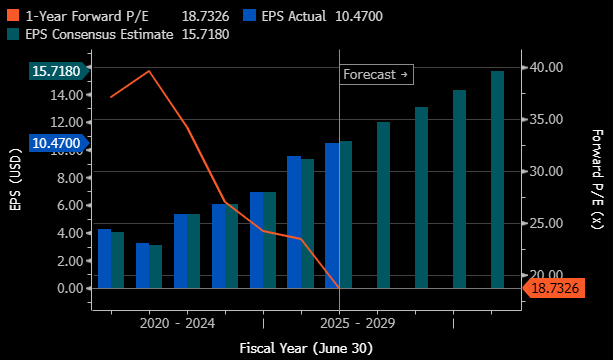
chart

ResMed EPS vs. Valuation (Forward P/E) – Source: Bloomberg
chart
ResMed EPS vs. Valuation (Forward P/E) – Source: Bloomberg
RMD is performing well and from our perspective it’s all about where the risk/reward is attractive following the negative interpretation of its latest result. Just as there are risks to RMD moving forward, some nice tailwinds are building as well:
- Aggressive capital returns: RMD plans around US$1.5bn in FY27 share buybacks, including an accelerated US$450mn repurchase funded by MatrixCare divestment proceeds. Together with a 10% dividend increase, total shareholder returns are expected to exceed US$1.85bn. The buyback is expected to reduce the share count by ~4%, supporting management’s 12–14% core EPS growth target.
- Underpenetrated market and GLP-1 opportunity: ResMed estimates around 1 billion people worldwide have obstructive sleep apnoea (OSA), leaving a substantial market for diagnosis and treatment. Wearables, home sleep testing and greater awareness are expanding the patient pipeline. GLP-1 drugs may also complement CPAP therapy, with users on both treatments showing higher CPAP initiation and resupply rates, potentially providing an additional volume tailwind.
- Margin expansion and connected ecosystem: RMD is targeting sustained gross margin improvement through FY30, supported by premium mask sales, manufacturing efficiencies and AI-enabled technology. Its connected AirView and myAir platforms improve patient adherence and support recurring mask and accessory sales, while AI tools such as Dawn and Smart Comfort aim to further improve compliance and strengthen customer retention.
Interestingly, the impact of GLP-1 drugs can be interpreted as a tailwind and a headwind. The negative impact of the latest result is likely to diminish over the next 3-months before we hear their 2Q27 numbers, but for now we would be more interested ~$30. The current market is not looking for bargains post-earnings into weakness, with the influence of quantitative and momentum traders being the likely reason we’re seeing more follow-through selling as opposed to dip buying.
- We like RMD; it’s a quality company, but it’s hard to see outperformance in the near future.
MM is neutral towards RMD above $33
Add To Hit List