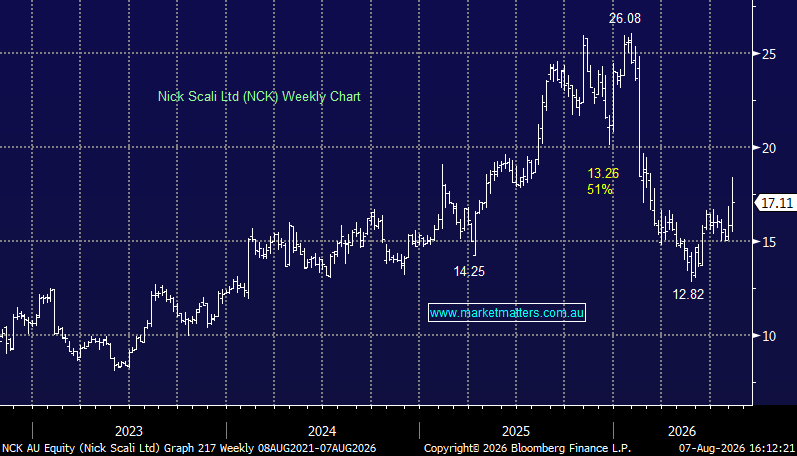
NCK -0.7%: delivered a solid FY26 result, with profit broadly in line with expectations and a stronger dividend, although the domestic trading backdrop remains challenging as softer housing conditions and cost-of-living pressure weigh on big-ticket spending.
Key highlights:
- Revenue of A$516.7 million, up 4.3% but around 3% below the A$533.3 million expected.
- Underlying NPAT of A$75.7 million, up 22% and broadly in line with the A$76.1 million expected.
- EBIT of A$125 million, a touch below market expectations around A$127 million.
- Final dividend of 39c per share, up from 33c and ahead of expectations.
The Australian and NZ business remains soggy, with written sales orders up 2.7% across FY26, but down 3.6% in the 2H as housing turnover slowed and store traffic weakened materially. Management said foot traffic was down by as much as 15% in the final quarter, reflecting the impact of higher interest rates, inflation and weaker household confidence.
Early FY27 trading has been better than feared rather than strong. Written sales orders in Australia and NZ were flat over the first five weeks, cycling high-single-digit growth in the prior corresponding period. New store openings should provide some support, with another four stores expected to open during the year.
The standout remains the UK. Losses narrowed to A$4.8 million in FY26 and the business moved into a small profit in the 2H, while like-for-like sales rose 19%. That momentum has accelerated into FY27, with written sales orders up 35% over the first five weeks as the Fabb Furniture turnaround and store rebranding begin to gain traction.
MM’s view: This was a resilient result in a difficult domestic environment. Australia remains soft and the sustainability of elevated gross margins is worth watching, but the UK turnaround is becoming increasingly meaningful and provides an important second leg of growth. Early FY27 trading was also better than feared, which helps explain the positive share-price reaction early on, but those gains were not retained into the close. The key swing factor from here is whether Australian housing activity and consumer confidence can stabilise while the UK business continues to scale.
MM remains long & bullish NCK
Add To Hit List