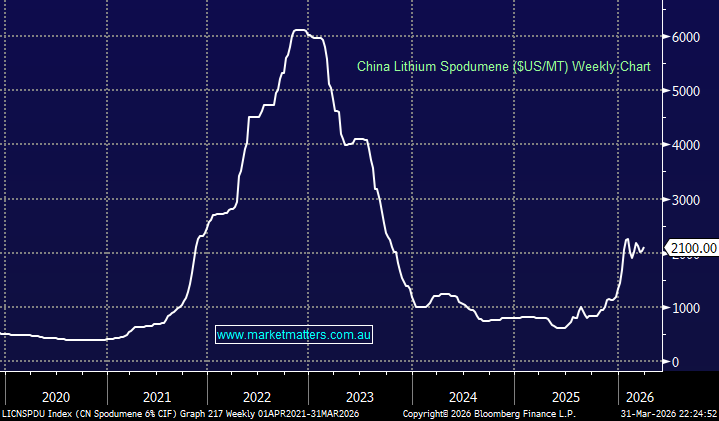
Lithium is moving out of its cyclical downturn and into a tightening phase, with demand broadening beyond EVs into energy storage and infrastructure linked to AI and data centres. At the same time, the supply response has been curtailed following the 2023–25 price slump, with producers cutting output and delaying projects. This has accelerated the shift back toward balance, with the market now edging toward a structural deficit as demand growth begins to outpace supply.
Importantly, lithium supply remains slow and capital-intensive to bring online, while governments increasingly view it as a strategic resource, adding another layer of constraint. The combination of stronger, more diversified demand and limited supply flexibility underpins a more constructive outlook for prices into 2026, with the market transitioning from a cyclical recovery story to one of tightening fundamentals.
Lithium supply response is slow and staged. In the short term, producers can only make modest adjustments through existing operations or restarts, while more meaningful increases take 1–3 years via expansions. Bringing on new supply is a long-term process, often requiring 3–7+ years due to permitting, funding and technical complexity, meaning the market struggles to respond quickly to rising demand.
We are now seeing a pronounced second wave of EV and hybrid adoption, with the Iran war adding a tailwind as fuel prices soar. Since COVID, EV adoption has moved from early adoption to mass scale, with penetration now above 20% globally and still climbing, underpinning a structural demand tailwind for lithium and battery materials. It’s the affordability and quality of Chinese vehicles, such as BYD, that are driving many purchasers – Chinese EVs now dominate the Australian market, enjoying ~80% of market share.
In terms of global sales, the number of EVs being sold since COVID is very impressive: In 2020, around 3 million EVs were sold, and this jumped to more than 20 million in 2025, or ~25% of total vehicle sales. Energy storage is the fastest-growing area for lithium use, albeit from a smaller base, but as the world gets a first-hand example of how vulnerable and dependent it still is toward fossil fuels, the demand story looks set to go from strength to strength.
- We are bullish towards lithium, initially targeting new highs ~$US2,500 through 2026, or ~20% higher.
MM is bullish towards lithium from the $US2100/MT area

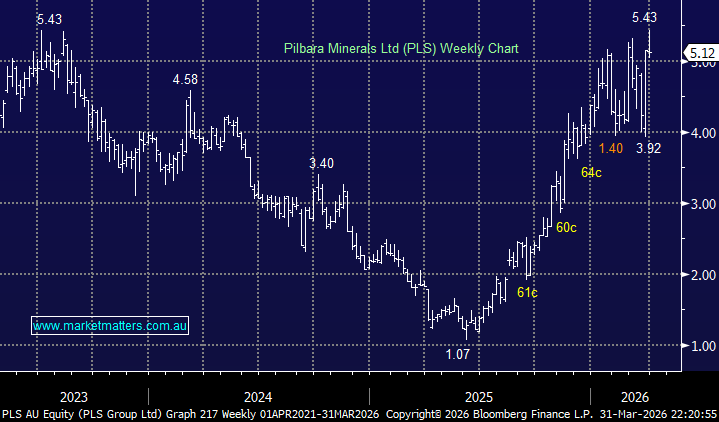
PLS reported solid numbers in February – Here. The lithium miner is back in profit making ~$33mn in 1H FY26 although it’s a small amount for a $16.5bn company. However, with the Ngungaju restart planned for FY27, the dial is set to turn in the coming years, with revenue forecast to jump ~60% from FY26 to FY27 and, more importantly EPS from 0.15 to 0.31.
While the outlook for Pilbara and lithium remains constructive into 2026/27, following the sharp rerate off 2025 lows as lithium prices recovered, there is a growing risk that previously mothballed supply returns to market, potentially capping further upside in spodumene prices. Bearing in mind that markets look at least 6-12 months ahead, we see better value in the copper and iron ore names that have been weighed down by Iran War headwinds as opposed to Pilbara, which has been a net beneficiary of the conflict.
- We can see PLS trading around $5 for much of 2026 following its five-fold advance from its 2025 low. and wouldn’t chase strength towards $6.
MM is cautiously bullish towards PLS around $5
Add To Hit List