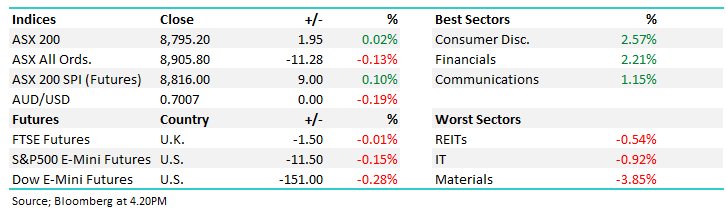
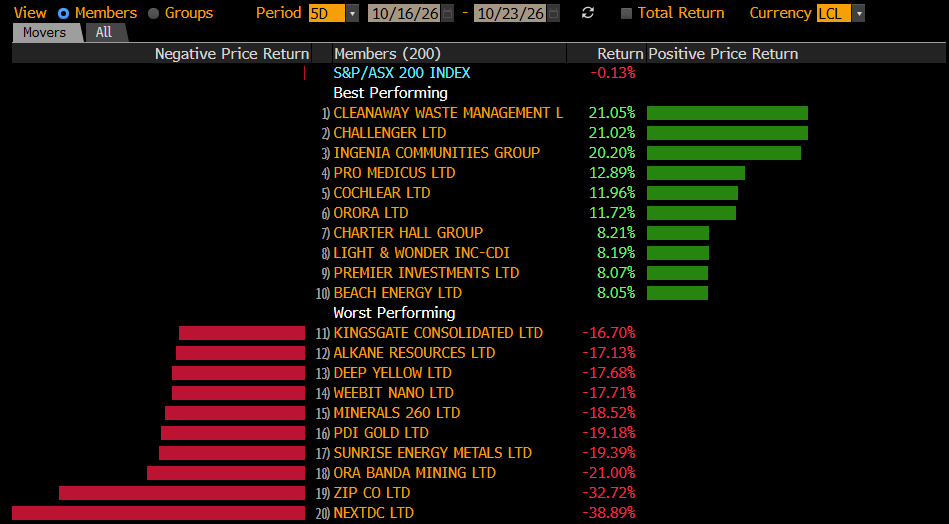
Over the last 3 months, the ASX consumer discretionary sector (+14.62%) has been the best-performing area of the market despite the Australian consumer backdrop remaining under meaningful pressure from several compounding headwinds. The recent positive momentum is suggesting things may be as bad as they will get:
- Inflation and rates: Australia’s inflation outlook remains challenging, and the RBA has raised the cash rate three times in 2026 to 4.35%.
- Housing slowdown: The cooling property market is weighing on home-related retailers as weaker housing turnover reduces demand for furniture, appliances and homewares.
- Shift to essentials: Consumers continue to prioritise essential spending over discretionary purchases, creating a tough environment for retailers.
- Middle East conflict: The Iran conflict has added to inflationary pressures, with Woolworths flagging early signs of customer disruption and rising input costs.
Heading into the August FY results season, there’s a fair degree of trepidation towards the retailers, with analysts holding a mixed outlook towards the sector; e.g. heavyweight JB Hi-Fi has 7 Buys, 5 Holds and 3 Sells, and over the last 4 earnings releases it’s moved an average of 7.2% on the day of the release as the diversified calls by definition see some get caught out.
Hence, it’s not surprising that the retailers have seen their valuations fall, but the question is, are they cheap enough for the economic backdrop touched on above?
- The overall picture is a sector now trading near or slightly above long-run average multiples, at a point in the cycle where earnings expectations are being cut, and the consumer outlook is still deteriorating, a combination that historically resolves through further multiple compression rather than earnings recovery.
At MM we don’t believe the RBA will hike rates again in 2026, although credit markets are still pricing in a 70% chance. However, our concern is housing prices, an asset class that usually takes time to both turn and bottom and at the moment the bearish sentiment is gaining momentum following the budget.
- Hence, at this stage we prefer JB Hi-Fi over the likes of Harvey Norman, as it’s less vulnerable as the housing market grinds to a halt.
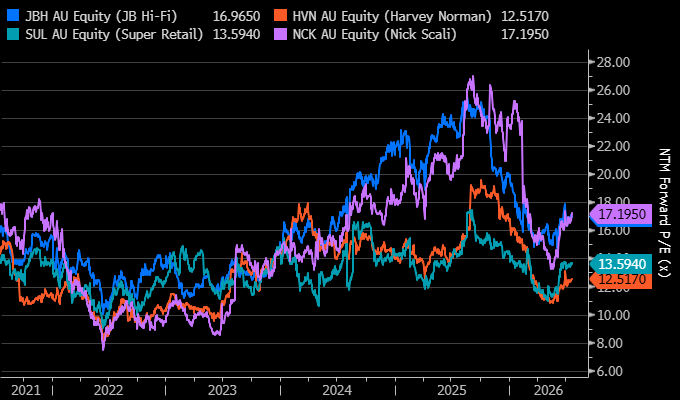
chart

Australian Retailers Forward P/E – Source Bloomberg
chart
Australian Retailers Forward P/E – Source Bloomberg
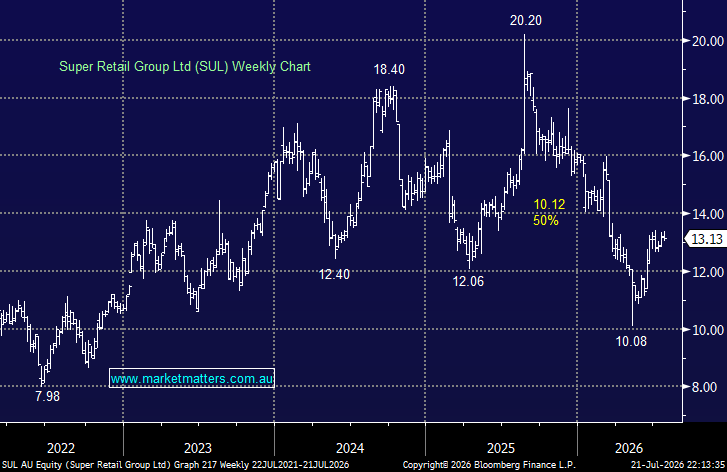
We don’t currently hold Super Retail Group (SUL), although we have owned the stock during the past year. The company operates four major retail brands—Supercheap Auto, Rebel, BCF and Macpac—which have collectively endured a difficult 12 months. While earnings remain sensitive to consumer spending, the business has limited direct exposure to the housing cycle, which provides some diversification relative to other discretionary retailers.
In early May, Super Retail disappointed investors with a weaker-than-expected trading update. Like-for-like sales increased by just 0.4% in the second half of FY26 to date, while gross margins declined modestly year-on-year. Management attributed the slowdown partly to disruption associated with the Middle East conflict across all four brands, although the market was unconvinced, sending the shares sharply lower to a fresh three-year low.
At last month’s investor day, SUL unveiled its “Ignite” transformation program, targeting $75 million in annual cost savings by FY29. The initiative will be funded within the existing capital expenditure envelope, although implementation costs are expected to be around $30 million annually over the next three years.
Management also outlined plans to expand the store network from approximately 790 locations to more than 900 by 2031, with a focus on regional markets and new store formats. Analyst reaction was mixed. While the longer-term productivity opportunity is meaningful, some questioned whether the five-year targets are overly ambitious, particularly the challenge of materially expanding the store network while simultaneously reducing costs and improving operational efficiency.
Traditionally, SUL has been a high-yielding stock, and buying it as earnings expectations turn higher can produce outsized returns. However, the company has historically maintained a relatively high payout ratio of around 70–75%, leaving dividend forecasts sensitive to changes in earnings. Consensus EPS estimates have already been downgraded by approximately 7.6% over the past three months, which have flowed through to lower dividend expectations.
The shares are becoming more interesting after the recent weakness, but the investment case still requires greater confidence that sales trends, margins and earnings expectations are approaching a trough.
- We believe SUL is a good company with strong brands, but the risk-reward is not yet compelling ahead of its result while consumer conditions remain uncertain and earnings revisions continue to trend lower.
MM is neutral towards SUL around $13
Add To Hit List