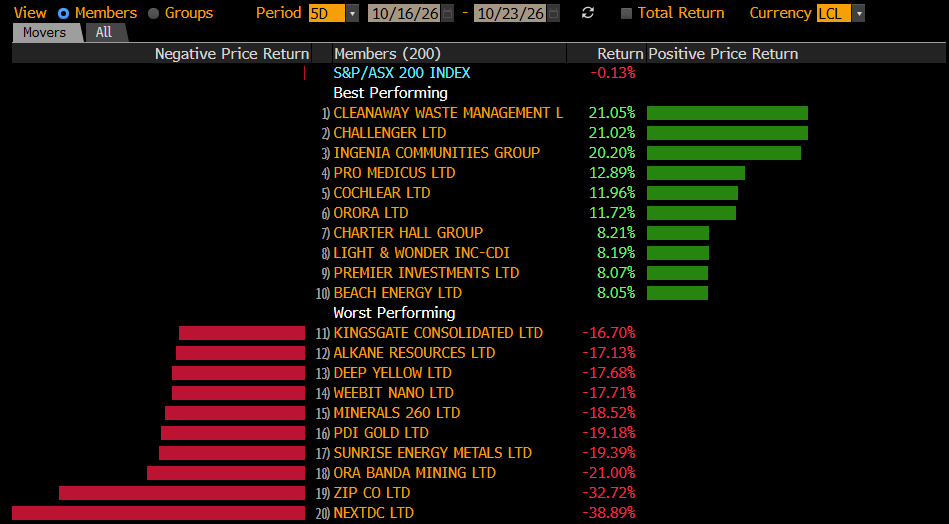
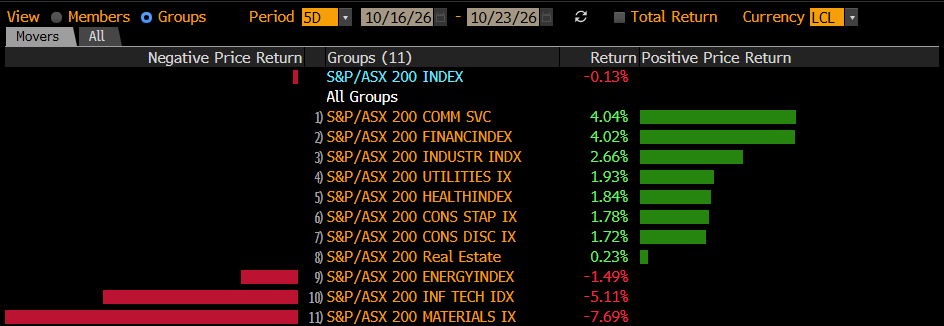
Australian major Data Centre operator NEXTDC (ASX:NXT) Is tapping the market for funds again: This time it’s undertaking a $1.5 billion (US$1.1 billion) capital raise, as demand for capacity at its facilities surges. NXT has consistently tapped equity markets over the last decade, almost annually since COVID, increasing deal size over time, as capital intensity rises with hyperscale and AI demand. To quantify this year’s numbers, NXT expects capex for the 2027 financial year to be about $5 billion, as it accelerates its S4bn project in Western Sydney to meet demand – huge spend for a company with a current market cap of $9bn.
2020: ~$672m equity raising to fund growth pipeline (cloud demand acceleration).
2021: ~$600m+ equity raising to accelerate hyperscale capacity.
2023: ~$618m raised to support Asia expansion ambitions and new projects.
2024: ~$1.3bn equity raise to fund AI-driven data centre expansion.
2025: ~$1bn hybrid (quasi-equity) raise to support long-term AI infrastructure.
2026: ~$1.5bn equity + expanded hybrid funding (~$2.2bn total package) to accelerate AI/hyperscale buildout.
Yesterday saw NXT go into a trading halt ahead of the raising, via an “entitlement offer” at $12.70 per share, a 10% discount to its closing price before the raise was announced. Importantly, the raise comes after OpenAI, in December, partnered with NEXTDC to build a $7 billion large-scale computing cluster in Sydney, part of a broader AI infrastructure partnership between the two companies.
- The offer: for every 5.4 shares owned, shareholders are entitled to buy 1 new share at $12.70. If you don’t already own NXT shares, you cannot participate in this component.
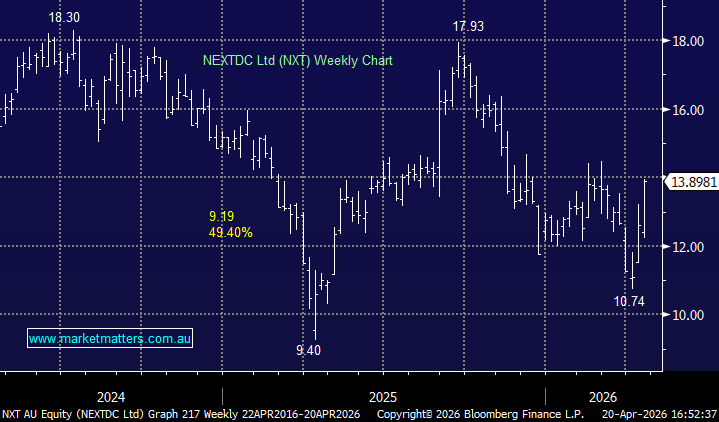
However, while demand is booming for NXT, the appetite for its shares has been muted of late, with the stock closing on Friday more than 20% below its 2025 high. So we ask why it is struggling in a booming environment?
Firstly, lets reflect on NXT as a company, it runs a beautifully simple business model — it’s essentially a landlord for the digital economy, but instead of renting office space, it rents physical space, power, cooling and security inside its data centres to businesses that need somewhere to house their servers and IT infrastructure. A simple summary:
- Business model: NEXTDC earns recurring revenue by housing customer servers in its data centres (co-location), with long-term, sticky contracts.
- Why it works: Once a customer moves their infrastructure in, moving it out is expensive and disruptive, driving predictable growth, supported by a strong order book and rising utilisation.
- AI tailwind: Surging AI demand is accelerating capacity uptake and future earnings visibility.
- The catch: The model is highly capital-intensive, with ongoing funding needs weighing on profitability.
NXT has grown into a $9bn ASX DC giant with revenue in FY25 of $427mn forecast to grow by ~70% to $726mn in FY27. However, although the company has delivered growing revenue and strong underlying earnings metrics, it still reports a net loss as it invests aggressively for the future. Competitive risks come from large international incumbents such as Equinix and other global operators that have bigger scale, deeper pockets, and broader geographic reach, but its recent tie-up with OpenAI is very encouraging.
- In December 2025, NextDC signed a deal with OpenAI to build what is planned to be the largest data centre in the southern hemisphere — a $7 billion AI campus at Eastern Creek in Western Sydney — with OpenAI locked in as the anchor tenant, providing NextDC with arguably the most powerful customer endorsement available in the global AI infrastructure race.
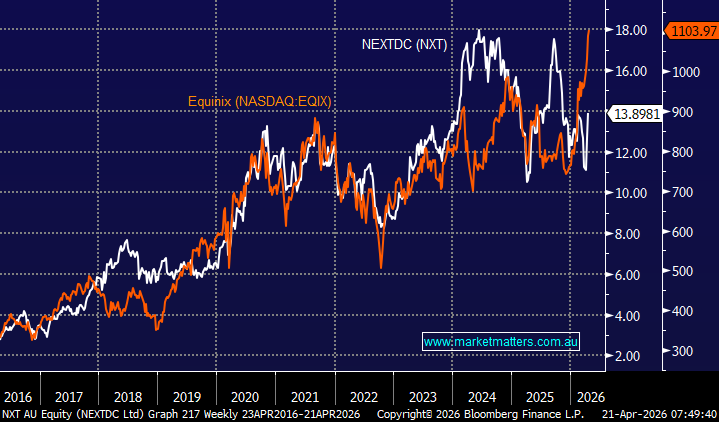
Valuation contraction has been significant across the ASX tech space, with NXT not immune, although it’s not as discounted on a historical basis as the likes of WiseTech and Xero. However, what really stands out is how it’s shaping up compared to its US peers Equinix (NASDAQ:EQIX) and Digital Realty (NYSE:DLR) both of which broke out to new highs in recent weeks – from a size perspective, Equinix is 17x larger than NEXTDC.
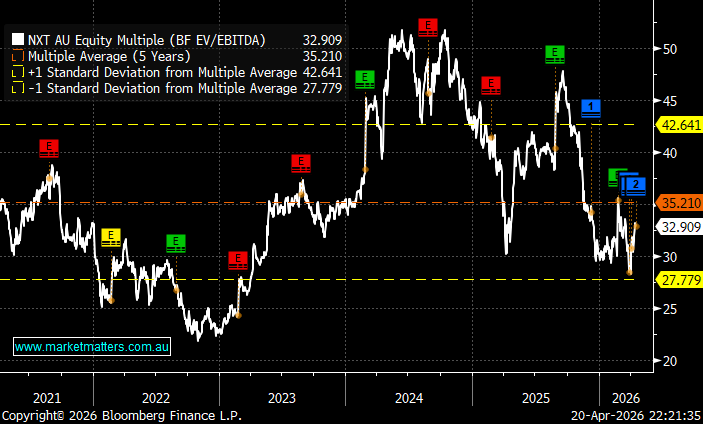
chart

NEXTDC Ltd (NXT) Valuation – Source Bloomberg
chart
NEXTDC Ltd (NXT) Valuation – Source Bloomberg
NXT is a younger, single-market operator still burning cash and years away from profitability, currently spending billions every year building infrastructure it hasn’t yet monetised. US goliaths Equinix and Digital Realty, by contrast, are mature global businesses that have already built their networks, generate billions in annual earnings, pay dividends, and benefit from powerful network effects across 30+ countries that NextDC simply cannot yet replicate. The demand story is identical across all three; AI and cloud are driving unprecedented appetite for data centre capacity, but the risk profile, income profile, and time horizon required are fundamentally different. In short, NextDC is the exciting construction site with the world-class blueprint; Equinix and Digital Realty are the finished buildings already collecting the rent.
NXT is roughly 10–12 years behind Equinix in its business evolution. Equinix was founded in 1998 and spent its first decade burning cash, raising capital and building infrastructure, exactly where NextDC is today. Equinix only reached consistent profitability around 2014–2015, converting to a REIT structure in January 2015, as the signal it had finally reached cash-generative maturity. NextDC, founded in 2010, isn’t expected to turn EPS positive until FY29, approximately 19 years after founding, a similar journey to Equinix’s. From a share price perspective, Equinix’s stock was volatile and range-bound through its capital-raising years, only beginning its sustained re-rating once profitability arrived and the REIT conversion locked in an income stream for investors.
- NextDC shareholders are backing the same playbook, just set in Asia-Pacific, a decade later, with AI supercharging demand at a scale Equinix never enjoyed in its early years.
If NextDC is the Equinix of the Asia-Pacific, and we believe there’s a credible case that it is, the question isn’t whether to own it, it’s whether you have the patience to ride out another 5–7 years before the real re-rating arrives. Equinix shareholders who held through the frustration were eventually very well rewarded. The key difference this time: the demand tailwind is significantly larger. Considering what’s played out with the likes of EQIX, we believe NXT’s rerating could occur sooner, i.e. in the next say 3-5 years.
- We feel likes its too early to buy NXT, but the stock still feels likely to advance through 2026.
MM is cautiously bullish towards NXT around $13 – post raise
Add To Hit List