Hi Lindsay,
SpaceX listed overnight in what was comfortably the largest IPO in history, raising US$75bn at a valuation approaching US$1.8tn, with the stock finishing around 19% higher on day one.
Firstly, the challenge with participating in IPOs like this is that success can actually work against you. If demand is enormous — which is usually what you want — allocations tend to be heavily scaled back and you end up with very little stock. If demand is weaker than expected, you generally receive a larger allocation, but then risk owning more of a stock that struggles post listing. That’s always the balancing act with high-profile IPOs.
As for your question — the more interesting issue now is not valuation, it’s index inclusion.
If SpaceX becomes eligible for inclusion into major indices such as the Nasdaq 100 under accelerated entry rules, passive funds that track those indices would eventually need to buy the stock in order to replicate the benchmark. These investors are not making a valuation call — they simply buy because the stock enters the index.
Normally that creates some demand but rarely changes the picture materially. SpaceX may be different.
Elon Musk and existing shareholders still own most of the company, meaning only a relatively small proportion of shares are actually available to trade (the free float). If index funds, active managers and speculative investors all try to build positions at the same time while available stock is limited, that can create a temporary supply-demand squeeze and push prices higher.
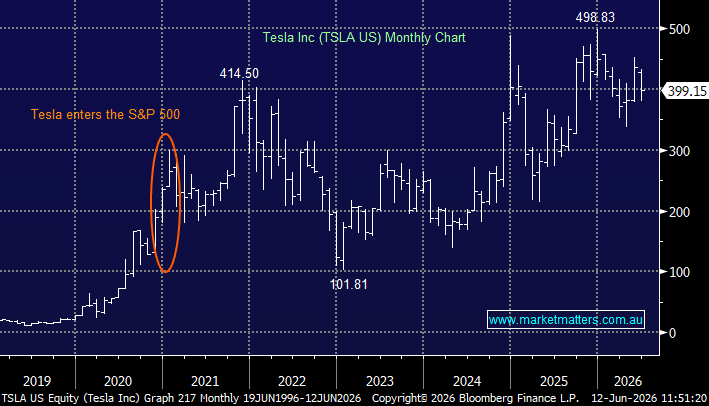
We’ve seen similar dynamics before. Tesla rallied strongly ahead of joining the S&P 500 as investors anticipated passive buying flows.
That said, passive buying isn’t unlimited and it isn’t permanent. Index funds buy once to establish their position, then flows normalise. Over time, lock-ups expire, more stock often becomes available and the market returns to focusing on what ultimately matters — earnings, growth and valuation.
Could buying pressure send the stock to Mars? Temporarily, technical factors can dominate fundamentals. Long term, however, even the biggest stories tend to trade back toward business fundamentals.
MM plans to remain interested observers only for now.