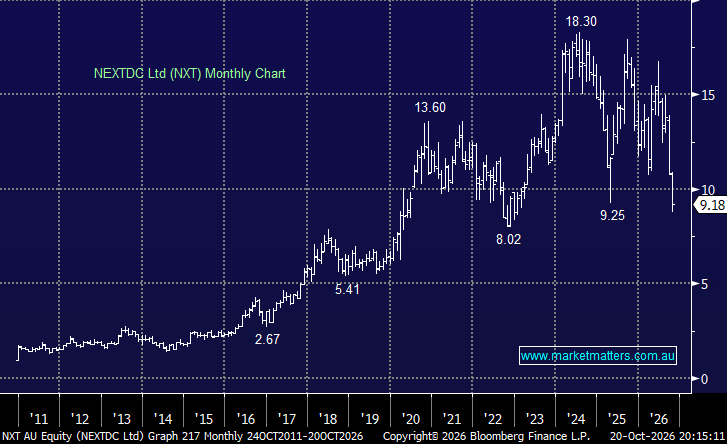
We wrote a note on NEXTDC (NXT) last week here, concluding: “We believe NXT is in an accumulation zone, but sentiment could easily drag it down towards its 2025 low, or 10% lower”, and that’s likely this morning. A lot has unfolded in the sector and company since last week.
NXT entered a trading halt on Monday as the company assessed a delay to power supply at its M3 Melbourne data centre (DC) and the potential impact on FY27 guidance – the stock will reopen this morning.
- The earlier-mentioned South Korean data-centre infrastructure company Elice Inc. plunged over 30% on its market debut, bad timing from a sentiment perspective for NXT’s reopening, though noting that Elice is a Neocloud operator, a different model to NXT.
NXT will resume trading this morning after assessing delays to the electricity supply at its M3 data centre – no news at the time of writing. According to the AFR, the delay relates to concerns raised by residents and councils about the installation of concrete power poles, some reaching 22 metres in height, with construction suspended in late September. On the surface, the impact appears manageable, with the power delay potentially reducing FY27 EBITDA by $30–35 million, or around 4% of NEXTDC’s previous guidance of $385–410 million.
- However, our broader concern is whether this is the beginning of a trend moving forward, i.e. the cost of doing business for DCs is set to rise in Australia.
The uncertainty probably couldn’t come at a worse time for NXT, with shares already under significant pressure following a broader sell-off in AI-related stocks. The problem highlights an increasingly important challenge for Australia’s rapidly expanding DC industry: securing reliable electricity supply to support power-intensive AI infrastructure.
NEXTDC’s business model is relatively simple: it builds and operates data centres, earning recurring revenue by leasing space, power, cooling and connectivity to customers. The upfront construction costs are significant, so the faster it can bring new capacity online and fill it with customers, the sooner it can generate revenue to help cover those costs and service its debt. The key distinction between NEXTDC (NXT) and CoreWeave (CRWV) – a Neocloud operator covered later is what they provide.
- NEXTDC supplies the physical infrastructure — the buildings, electricity, cooling, security and connectivity — while customers install and operate their own computing equipment or arrange for others to do so.
- CoreWeave provides the computing power itself, deploying large fleets of NVIDIA GPUs, networking and software to help customers train and run AI models, using a combination of leased data-centre facilities and infrastructure arrangements. Neoclouds can be tenants of NXT, with Sharon AI a current example.
In other words. NEXTDC is selling the picks and shovels of the digital economy; CoreWeave is selling the computing power that drives it. However, both have come under intense pressure in recent times as the sector dramatically came off the boil.
- NXT and its peers have faced a tough period recently, as rising bond yields have weighed on the premium investors are willing to pay for future earnings, adding to uncertainty around the “AI trade.”
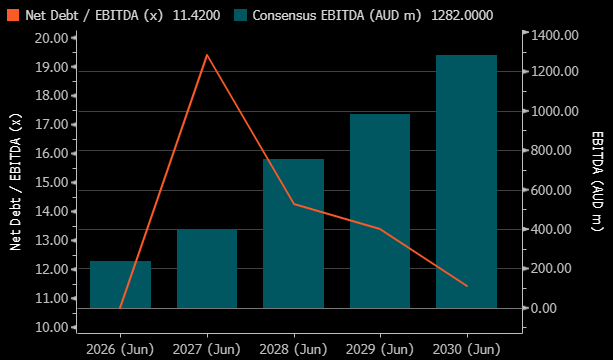
NEXTDC’s balance sheet reflects the enormous upfront cost of expanding its data centre network. At 30 June 2026, it had net debt of ~$2.5bn, almost 10x FY26 EBITDA of $249m. While leverage is high, new facilities take time to generate revenue, with contracted EBITDA of more than $715m providing visibility over future earnings as capacity comes online.
Funding flexibility remains strong, with pro-forma liquidity of around $5.9bn, access to an $8.2bn senior debt facility and FY27 capex of approximately $5.5bn described as fully funded. With no major debt maturities before 2029, the key risk is execution rather than immediate funding: NEXTDC must convert its substantial investment into earnings and cash flow on schedule. The forecast earnings ramp-up below highlights the potential to reduce leverage if delivery stays on track.
- We don’t believe NXT’s current leverage is alarming given its development pipeline and contracted earnings, but it does leave less room for operational setbacks, such as M3, which places pressure on interest coverage.
chart

NEXTDC: Forward EBITDA Ramp-Up & Net Debt/EBITDA – Source: Bloomberg
chart
NEXTDC: Forward EBITDA Ramp-Up & Net Debt/EBITDA – Source: Bloomberg
Importantly, NXTs FY27 capital expenditure is fully funded, providing some comfort despite net debt being forecast to climb towards $10.6bn by FY29. That said, ongoing access to debt and equity markets is very important for NEXTDC as they build out their development pipeline.
- NXT’s bonds have been trading only 2bps lower this week, offering a yield to maturity of approximately 8.2% to April 2030; i.e., importantly, there has been no panic selling.
While the impact from M3 is not insignificant, we do not believe it materially changes the outlook. Power availability and infrastructure delays are inevitable challenges facing the global DC industry, rather than risks unique to NEXTDC. However, the announcement has coincided with broader weakness in US and Korean technology stocks and sentiment towards the data-centre sector, with the million-dollar question being how NXT will open today and whether it will be a buy.
- We believe NXT’s ~$7b market cap isn’t too onerous considering the runway ahead but the share price needs to reflect further implementation risks to offer enticing risk/reward.
Another interesting recent development has been the family behind SKS Technologies, the electrical company holding the contract for M3’s power infrastructure, selling more than $100mn of NXT stock in a “well-timed” move earlier this month – somewhat disconcerting and likely to weigh further on the NXT share price this morning. We believe NXT is closer to a buy than a sell but these situations do have a habit of undershooting on the downside as investors adopt an if-in-doubt, get-out approach.
- While we haven’t yet heard from NXT around M3, a panic sell-off towards $8 wouldn’t surprise us, and we would rather see the dust settle before considering whether or not it’s a buy.
MM is neutral towards NXT around $9
Add To Hit List