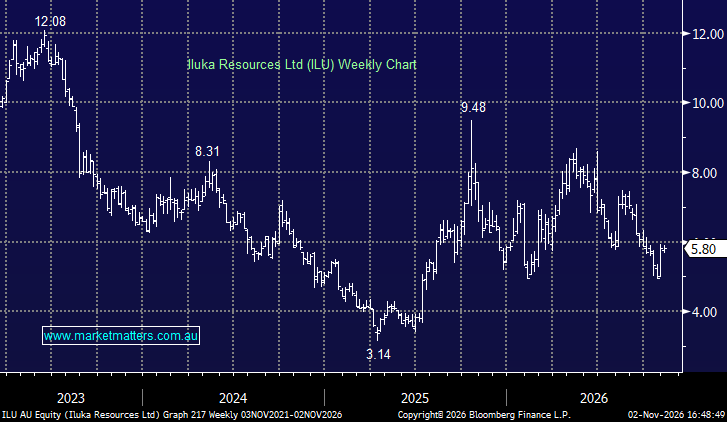
ILU is a very different company to LYC when it comes to rare earths; today it’s a mineral sands operator forecast to generate $922mn revenue from its traditional business, with rare earths revenue not expected until 2028. However, by FY30, total revenue is estimated to come in around $2.2bn as the rare earths contribution builds. Hence, ILU is set to become a diversified miner with dependency on two very different markets:
Mineral Sands: prices are driven primarily by construction and industrial activity. Zircon is used in ceramic tiles and sanitaryware, while rutile and synthetic rutile are key feedstocks for titanium dioxide pigments used in paints, coatings and plastics. Hence demand tends to track global building cycles, particularly in China, the largest consumer, while supply concentration among a handful of major producers, including Iluka, Tronox and Kenmare, provides an additional influence on pricing – China’s property slowdown has weighed on ILU.
Rare Earths: As discussed earlier, the profitability and value associated with this growth business area will be largely driven by China.
Currently, this $2.5bn business is forecast to lose $65mn in FY26 due to heavy Eneabba construction costs as it develops its rare earths refinery. The company is not expected to return to profitability until FY28, when Eneabba rare earth revenue begins flowing. The reason to consider ILU is almost entirely around its rare earths evolution, with risks concentrated there: construction delays, feedstock availability, commissioning complexity, and NdPr price assumptions. The mineral sands business provides little earnings support in the interim, and the variable-rate $1.6bn government loan for Eneabba means the cost of delay compounds over time, i.e. rate hikes directly increase ILU costs.
- We can see ILU improving over the coming years, but there are still several variables that make the investment argument hard to embrace.
MM is neutral toward ILU ~$6
Add To Hit List