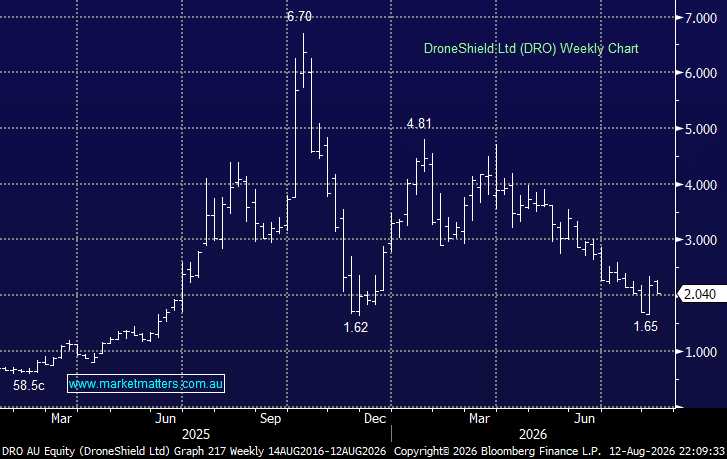
Counter-drone technology company DRO produces systems that detect, track, and defeat unmanned aerial threats i.e. how wars will be fought in the next decade. The stock, like the sector, surged dramatically in 2023–24 on the back of Ukraine-driven demand but has given back significant ground since late 2025 following one of the most significant corporate governance crises on the ASX in recent years:
- The governance issue began in November 2025, when CEO Oleg Vornik, Chairman Peter James and director Jethro Marks sold around $70m of shares, including Vornik selling his entire ~$50m stake. The timing proved particularly damaging, with some sales occurring while the market was operating under a misleading announcement; DRO subsequently suffered its worst one-day fall on record (-31%).
- Management instability quickly followed, with US CEO Matt McCrann departing in November before Vornik and James both exited in April 2026. The departures compounded concerns around governance and contributed to further sharp share-price volatility.
- DroneShield has since moved to rebuild investor confidence, introducing tighter trading and disclosure policies, minimum shareholding requirements for directors and executives, and changes to remuneration structures following an independent governance review.
However, the stigma around the issue hasn’t completely disappeared, and it’s the primary reason MM hasn’t considered DRO in recent years. While the operational growth story remains compelling, rebuilding trust in the board and management remains an important part of the DRO investment case through 2026/7, i.e. they need to go above and beyond!
Moving on from the above negatives, DroneShield has emerged as one of the ASX’s fastest-growing companies, with FY25 revenue up 276% to $216.5m, while the business moved into profitability with $35m underlying net profit. More importantly, the opportunity ahead remains substantial: DRO entered FY26 with around $80m of contracted orders and a broader $2.3bn sales pipeline spanning almost 300 opportunities, including 18 potential contracts worth more than $30m each. For FY26, consensus expects $261m revenue, but profit is tipped to slide back to ~$12m.
Overall, we continue to think the structural backdrop remains supportive as governments accelerate spending on counter-drone technology following conflicts in Ukraine and the Middle East.
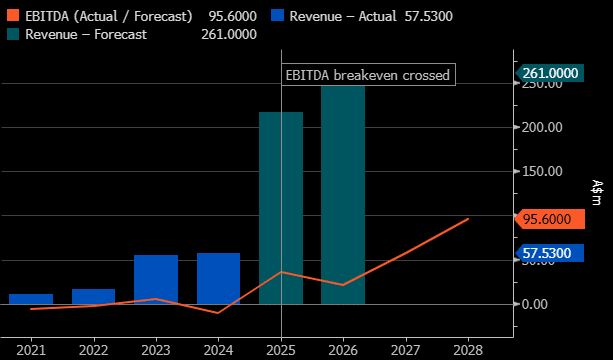
chart

DroneShield (DRO) – Revenue & EBITDA: Source – Bloomberg
chart
DroneShield (DRO) – Revenue & EBITDA: Source – Bloomberg
The $1.9bn valuation already reflects plenty of this optimism. DRO trades on around 8x EV/Revenue, broadly comparable with high-growth defence technology peers such as Curtiss-Wright (7.3x) and Kratos (7.0x), but well above slower-growing traditional defence companies. The key for us is pipeline conversion. The $2.3bn opportunity set provides enormous upside relative to DRO’s current revenue base, but it remains a pipeline rather than contracted revenue, and government defence procurement can be notoriously lumpy. Following the stock’s sharp pullback from its highs, we believe the risk/reward has become more interesting as the growth story remains intact, but further upside will increasingly depend on converting large opportunities into firm orders and demonstrating that revenue growth can translate into sustainable earnings and margins.
We briefly discussed DRO this time last month here, when the stock was ~10% higher, but back around $2 we were removing our bearish cap, although we’re reticent to switch totally to a bullish stance.
- We can see DRO trading between $1.50 and $3 over the coming year – i.e. more a stock suited to active trading.
MM is now neutral towards DRO around $2
Add To Hit List