I (James) was on Livewire’s Buy Hold Sell a couple of weeks ago with Matthew Kidman and Jun Bei Liu from TenCap. We were asked to pitch an income stock we liked here and now — (the episode is here for those interested). I pitched Charter Hall Long WALE REIT (CLW) which we had recently bought in the Market Matters Income Portfolio, while JBL chose Challenger.
We have historically viewed Challenger as a fairly complex business. It is primarily an annuity provider, but it also carries a large investment portfolio designed to support the future liabilities those annuities create. That complexity has kept us on the sidelines, but we now think CGF is worth another look, supported by some interesting research from UBS, which has a Buy rating and an $11 price target.
As an investment, Challenger offers an interesting blend of valuation support, improving income and exposure to Australia’s ageing population. CGF is best known as Australia’s dominant annuity provider. Its core Life business sells term and lifetime annuity products to retail and institutional customers, effectively providing retirees and other investors with guaranteed income streams. It also has exposure to funds management, although the recent deal to merge Fidante with Channel Capital should leave the group more focused on its higher-quality Life division.
While the business itself is complex, the investment case is becoming easier to understand. Australia has a growing retirement income challenge, and Challenger is one of the few listed companies directly leveraged to that structural theme. More people are moving into retirement, demand for dependable income products should grow over time, and the regulatory backdrop appears to be improving.
The Fidante transaction also helps clean up the story. Challenger has agreed to merge Fidante with Channel Capital to create Channel Group, a larger funds management platform with around $150bn in AUM. CGF will retain a 45% stake in the combined business and receive $172m in cash proceeds, while booking a $100m pre-tax gain on sale in FY27. Importantly, the near-term earnings impact appears modest, while the deal allows management to focus more clearly on growing the Life business.
This is an important development because the Life division is where the upside sits. UBS points to improving momentum across retail annuities, institutional term annuity-backed notes and offshore reinsurance through Challenger’s new Bermuda-based Calix Re entity. Regulatory capital changes from 1 July 2026 are also expected to free up around $300m of capital, giving the company more flexibility to support annuity book growth or, over time, capital management.
Valuation is another key attraction. At current prices, CGF is trading on roughly 14.6x FY27 earnings, falling to 13.5x FY28, with UBS forecasting EPS growth of around 6% in FY27 and 8% in FY28. That is not screamingly cheap in absolute terms, particularly for a stock that has already performed well, but it looks reasonable given the quality of the Life franchise and the improving growth outlook.
The yield also adds appeal. On UBS estimates, dividends are tipped to be 30.5c in FY26, 36.5c in FY27 and 39c in FY28, implying a dividend yield of around 3.1%, 3.7% and 4.0% respectively – plus franking. CGF is not a high-yield stock in the traditional sense, but the direction of travel is positive, and the payout ratio remains broadly sensible. For investors seeking income with some growth attached, that combination is appealing.
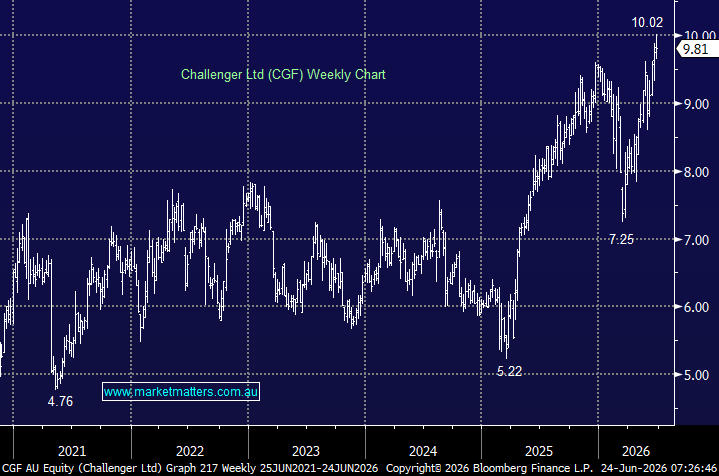
The main risk is that Challenger remains exposed to markets, asset values and the quality of the investment portfolio backing its policyholder liabilities. It is also a business where confidence can shift quickly if annuity sales disappoint, spreads compress, or capital settings become less favourable. The stock is no longer the deep-value opportunity it was, closer to $6–7, but the business has also become cleaner and better positioned.
Overall, CGF looks interesting, and we’re adding it to the Hit List, although we have no plans to chase it after a strong move. The valuation still looks reasonable, the dividend yield is improving, and the Life business has a clearer structural growth runway than it has had for some time. If Challenger can keep growing annuity sales while recycling capital effectively, the stock can continue to grind higher.
MM is mildly bullish CGF ~$9.80
Add To Hit List