Hi Ian,
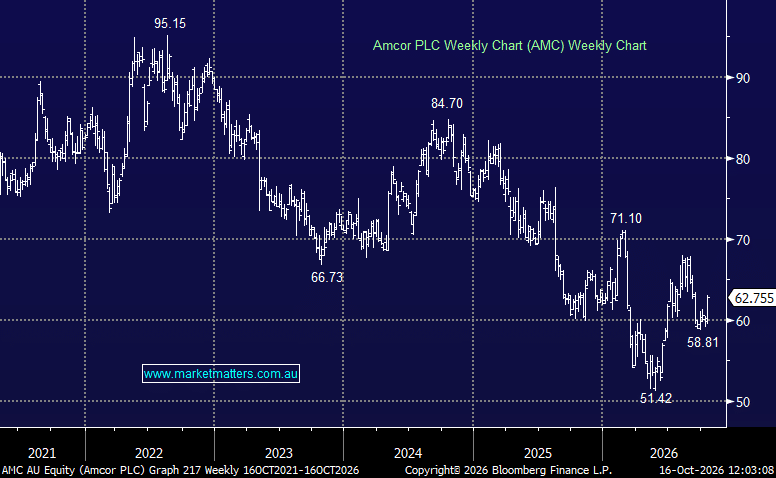
Amcor does have some debt maturing in January 2027, ~$800m of its total debt of around $13bn, which is currently financed at rates below 2%. Refinancing at today’s rates would add approximately $40–50m p.a. in interest costs for that tranche.
Its broader debt maturity profile is relatively evenly spread, with $1.7bn due over the next 12 months, a similar amount in 2028, about $2.1bn in 2029, $1.2bn in 2030, and around $6bn thereafter.
Free cash flow is currently around $1.3bn, against annual dividend payments of approximately $1.19bn, leaving very little surplus cash for debt reduction. This means FY27 deleveraging is heavily dependent on a recovery in working capital and proceeds from asset sales.
Asset sales and working-capital improvements are central to Amcor’s deleveraging strategy. The company has identified businesses with combined annual sales of approximately $2.5bn for potential restructuring or divestment. To date, it has realised around $500m from asset sales, and from what we can tell, there could be another ~$1.5bn to come.
The working-capital component is also important. Under more normal conditions, free cash flow should be closer to $1.8bn annually. FY26 was unusually weak because management deliberately increased inventory holdings due to supply-chain uncertainty associated with the Middle East conflict. As those inventory levels normalise, cash generation should improve materially.
Ultimately, Amcor carries a significant amount of debt, but it is supported by a business with relatively stable earnings. The Berry acquisition was approximately $10bn, alongside the assumption of around $5bn in debt, which explains much of the current leverage. At this stage, we view the debt burden as elevated but manageable, although a further sustained increase in bond yields would certainly be unhelpful for AMC. This is something we’re watching closely.
In terms of CLW and MGR, if bond yields continue to rise, their share prices are likely to remain under pressure. However, we believe the opposite scenario is more likely, with yields potentially having already peaked, although time will tell.
Our preference is to fade the current move higher in bond yields, positioning for an eventual reversal. This is consistent with our recent decision to buy back into the interest-rate-sensitive JB Hi-Fi (JBH) and add to our existing position in Mirvac (MGR).