Hi Charles,
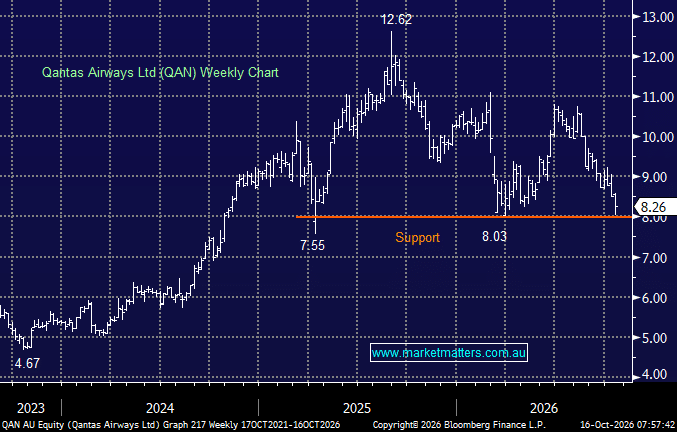
The biggest issue for Qantas (QAN) right now is fuel. The conflict in the Middle East has pushed jet fuel costs higher. Fuel is the airline’s single largest cost line, so every sustained move in oil flows quickly into margins. Hedging only delays the pain, it doesn’t remove it, but if the conflict ends soon, it would ease a lot of that pressure. However, we can’t time it with any confidence, and until it happens QAN is operating in a tough environment.
Jet kerosene futures average US$165.3 through the end of the 2H26. Qantas buys 16 million barrels of jet kerosene per half to fuel their planes. Based on those figures, the increased fuel costs add around $600m to QAN’s cost base this half. To recoup the input cost rise QAN would have to raise air fares on average by +4.5% – we can’t rule out fare increases but that inherently comes with risk to volumes.
Aside from the fuel price increases, when looking at Qantas we see three key issues – valuation, yield and their balance sheet.
First, valuation looks cheap, but the estimates are falling. QAN trades on ~8.1x FY27 earnings, only slightly below its historical average of 8.4x and consensus has FY27 EPS around 94c, rising towards $1.20 in FY28. However, almost every line in the forecasts are downgrades. A low P/E on earnings that keep shrinking is how value traps form.
Second, the yield isn’t as safe as it looks. The ~6.8% gross yield is backward-looking. Dividends have already fallen ~25% over the past year, and the FY27 forecasts are being revised down as well with consensus FY27 dividend yield of about 4.28% or ~6.1% grossed up.
Lastly, Qantas’ aging fleet is an issue which will stretch the balance sheet and impact capital returns (dividends, buybacks) for shareholders. Fleet renewal means capex of over $2bn every half for the next few years. Free cash flow is forecast to be negative through FY27, and net debt is expected to climb from ~$7.1bn to ~$8.4bn by mid-2028.
On the flipside, if fuel prices ease and demand holds, QAN could re-rate sharply from here, so the rebound potential is there. However we’re not really being paid to wait. Instead, we’d be getting paid a falling dividend to take on fuel, geopolitical, demand and capex risk.
QAN sits in the too-hard basket for now. We’d rather wait for clearer signs that the conflict is resolving, or for earnings downgrades to stop, before getting involved, even if that means paying a higher price.