Hi Matthew,
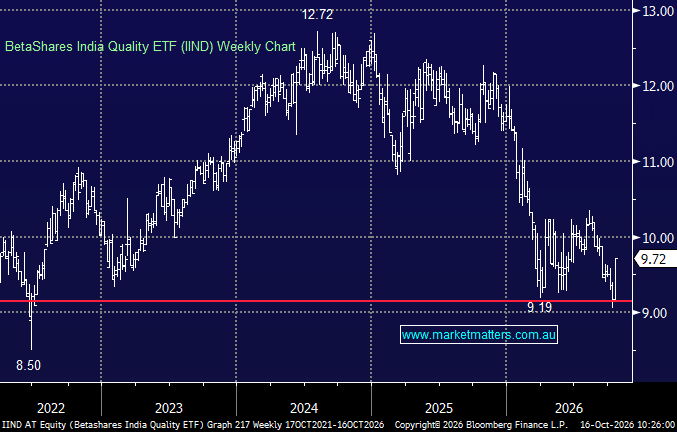
India has long been touted as an attractive long-term growth opportunity, supported by its expanding middle class, rising domestic consumption, infrastructure investment and favourable demographics. Its large domestic market and growing services sector provide structural growth drivers, while urbanisation and productivity improvements offer further potential. However, potential economic growth doesn’t automatically translate into strong investment returns, and there are plenty of reasons to be cautious toward the world’s most populated country’s stock market.
Looking through the eyes of an investor allocating capital in the current environment, the question is whether its earnings growth justifies the valuation and additional risks relative to other global equities, such as the US or our local Aussie market.
On the back of historic growth from the AI trade, analysts are forecasting S&P 500 earnings growth of 32.4% for calendar 2026, with 3Q expected to deliver 29.5%, which would be the third straight quarter above 25% and the eighth consecutive quarter of double-digit growth. That has been one of the strongest years for US corporate profits outside of a post-recession rebound, and it hasn’t just been a tech story: every sector in the index is expected to grow earnings this year, the first time that has happened since 2009.
India, by comparison, has been stuck in the slow lane. India’s index is weighted toward IT services, which are being disrupted rather than boosted by AI. At the start of the period, consensus was looking for only 6% growth in FY26, with a recovery to 16% expected in FY27. Those FY27 numbers are now all over the shop. JM Financial lifted its FY27 Nifty earnings forecast to 17.1%, while BofA cut its estimate to 8.5% on higher macro risk. More realistic commentators are landing in the middle, suggesting 10–11% EPS growth looks a reasonable expectation for FY27. I was talking to one of our external developers during the week who ran a team of 30 in India – which he has just cut completely. The tech grunt work (coding etc) that was getting done in India on the cheap, is being replaced by AI, and that’s a real risk to India’s economy in the shorter term.
The other issue is forecasting difficulty. Our observation over the year has been that most economics have trouble forecasting India’s growth. For example, consensus went into FY25 expecting around 15% Nifty earnings growth, and actual growth came in at just 3.4%. Paying up for growth that keeps getting downgraded is a poor trade. The good news for India bulls is that this year’s sell-off has done some heavy lifting on valuations. The Nifty’s forward P/E has eased from 21.3x back toward its long-run average of 18.3x. Okay, but not glaringly cheap.
India remains a compelling long-term story, but stories don’t pay returns, earnings do. We’d need to see three things before getting more constructive on India: earnings upgrades rather than downgrades, a stabilisation in the rupee, and a turn in foreign flows.
In terms of your query on ASX small caps, they still trade at a discount to large caps given the impact of higher rates on growth valuations, and the market tends to undervalue their dividends, even when a well-covered yield is often the main thing holding up total returns when share prices go sideways, though as we know, can also be a yield / value trap.
- NZME (NZM): A New Zealand media group that runs radio and audio brands (including iHeartRadio NZ), the NZ Herald in print and digital, and the OneRoof property listings platform.
- It looks cheap at roughly 9x fwd PE. EPS rose 45% to NZ$0.094, net debt fell NZ$8.6M to NZ$15.5M, and the dividend was held at NZ$0.09 per share.
- The consensus fwd yield is high at about 8–9%, but it carries no Australian franking.
- XRF Scientific (XRF): A Perth-based maker of precious-metal labware, fusion instruments and chemical fluxes used to prepare samples for analysis in mining, cement and industrial labs worldwide.
- This is the best pick of the three, and it’s priced like one. It trades on about 26x trailing earnings and 22x fwd.
- The yield is low but well covered and growing. It yields about 2.5% fully franked on a roughly 48% payout ratio. The dividend has risen for 8 consecutive years.
- MyState (MYS): A Tasmanian-based banking and wealth group that offers home loans, deposits and asset finance through MyState Bank and Bank of us, plus trustee and funds management through TPT Wealth.
- Valuation sits in the middle at around 13x earnings. Price to book is about 1.1x, and consensus EPS for next year is around A$0.36c.
- It yields about 5% fully franked (around 7% grossed up), based on FY26 dividends of 12.5c for the final and 12c for the interim, both 100% franked.
Of the three, XRF is our preference because it gives cyclical growth leverage to mining and resources, which is one of our preferred sectors at the moment. XRF’s fluxes, platinum labware and fusion instruments are essential to how mine and exploration labs prepare samples for assay. Strong gold and copper prices drive more drilling, more samples and more consumables usage, and also lifts demand for its capital equipment.