Hi Carl,
Firstly, for those less familiar with RMBS (Residential Mortgage-Backed Securities), they are a bond-like investment backed by a pool of residential home loans. A lender bundles mortgages together and sells securities that receive the interest and principal repayments from those borrowers. Investors typically earn a floating or fixed return, with different “tranches” offering varying levels of risk and return, depending on their underlying quality/safety. Asset Backed Securities (ABS) are similar, but the underlying assets include things like car loans, credit-card receivables, personal loans and equipment finance.
Australia’s securitisation market remains deep and active, with ~$76bn of public RMBS/ABS issuance in 2025, only slightly below 2024’s record $77.6bn. Non-bank RMBS issuance was particularly strong at ~$38.9bn as non-bank lenders continued taking mortgage market share, while forecasts suggest total issuance of ~$80bn in 2026 . In other words, the underlying pool of investable securities is expanding rather than contracting, making outright scarcity less of a concern.
- GCI’s ~$1.4bn is meaningful but not limitingly so taking into account the markets size.
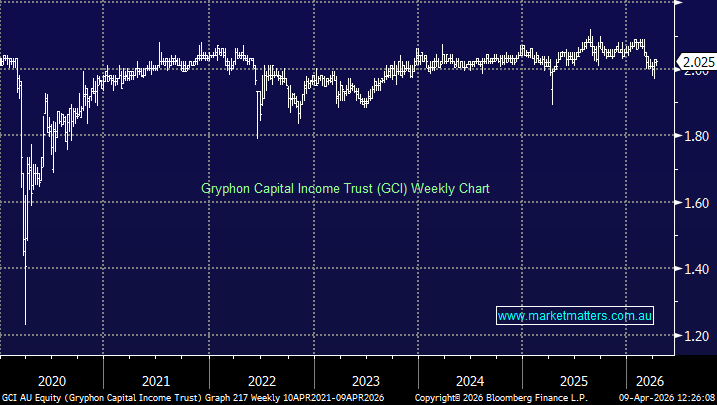
GCI has a good track record of only taking additional capital when they have can deploy it sensibly – without materially compromising portfolio quality or returns – and we think this is the case this time around, with GCI explicitly saying as much in their documentation on the raise.
We don’t see any issue’s around a shortage of RMBS/ABS, but competition for high-quality securities could compress credit spreads. If Prime RMBS spreads continue tightening, there is a risk that GCI could face pressure maintaining its +3.5% target margin over the RBA cash rate without going up the risk spectrum, but we’re not seeing signs of this yet;
GCI’s current portfolio:
- Investment grade: ~68% — AAA 2%, AA 9%, A 28%, BBB 29%
- Sub-investment grade: ~26% — BB 20%, B 6%
- Not rated: 3%
- Cash: 2%
On the asset side, it is still heavily mortgage-backed: 49% Prime RMBS + 20% non-conforming RMBS, so roughly 69% residential mortgages. The balance is 11% auto ABS, 10% consumer ABS and 6% SME ABS, plus cash.
Important to note, GCI is not a high-grade bond portfolio. Only about 11% is AA or better, while almost half the fund is BBB or below. That is deliberate – Gryphon is taking exposure to the more junior/mezzanine parts of securitised structures to generate a higher yield.
However, the rating of the security is different from the quality of the underlying borrowers. A BBB or BB tranche of a prime RMBS can still be backed by a diversified pool of good-quality Australian mortgages; it simply has less protection from losses than the senior AAA tranche.
The key is to keep monitoring the composition of their portfolio to see if these trends change, with any meaningful shift toward higher-risk securities warranting attention. We would watch its portfolio mix over coming quarters for any material increase in non-conforming or lower-rated exposure.
Overall, we think Gryphon is a good, sensible manager and the underlying portfolio is performing as it should, currently paying a yield of 8.24%.