Skip to Content
scroll

Bond ETFs etc

Our Q&As are emailed in our Saturday Morning Report, find the answer to this question below.

The Latest Q&A

Question asked

Bond ETFs etc

Dear learned team, I have asked you about bonds in the past, can’t quite shake the feeling that perhaps I should be somewhat invested in them given my SMSF is in retirement phase. The upshot was I established a small position in IAF. Since then they have gone down in value and I don’t think the yield compares to the approximately 5% I am getting from an at call bank account, and IAF’s long term returns look extremely average. Presumably the time to buy and profit from them, more than from bank interest, is when interest rates start to turn down (I think at the time, not so many months ago you were of the view that our interest rates were unlikely to go higher), or when the market starts betting that they are about to turn down? When/ if that happens I have the feeling AGVT might be a better instrument to capture some upside. I’m not sure that bonds necessarily protect against market downturns as they used to, well certainly not in inflationary periods. Have I got this right? Perhaps you could also comment on the other income ETFs such as CRED and HBRD. Am I better to stick with my cash and the bank interest and use it for opportunities in the share market as they arise rather than buying into any of these for income? Thanks so much for all your ongoing sage (non-financial advisor) advice. Pietro PS hope I’ve made the deadline. I’m in WA and kept thinking I had until midday, but my midday is later than yours.
Answer

Hi Pietro,

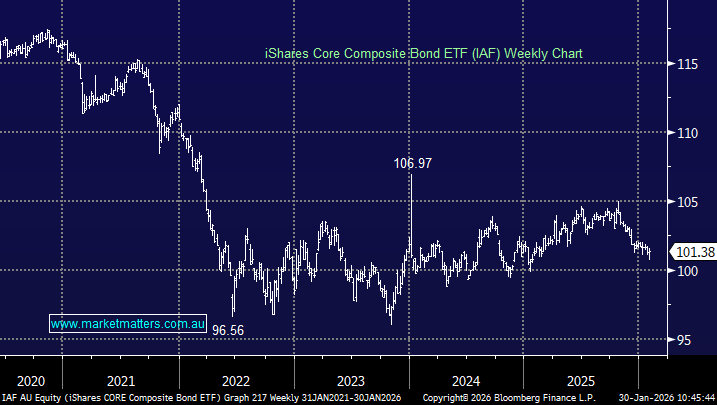
  • As the chart below shows the IAF ETF has been weighed down by rising interest rates/bond yields which courtesy of the US-Iran War haven’t improved as fast as we thought they would.
  • The IAF is yielding less than the ~5% bank on call but if/when yields do turn lower it will come into its own.
  • As you say in inflationary periods, bonds can lose some of their traditional defensive qualities because rising inflation and interest rates push bond yields higher and prices lower – just as we’ve seen in 2026.
  • CRED: Holds mostly fixed-rate corporate bonds, so falling yields are positive for its price, while rising yields are a headwind. With duration around 6 years, a 1% move in yields could move bond prices by roughly 6% in the opposite direction.
  • HBRD: Holds predominantly floating-rate credit and has much less interest-rate sensitivity. Higher rates generally boost its income, while rate cuts reduce income, but its capital value should be less affected than CRED.

From a portfolio construction perspective, we like the idea of diversification to mitigate the risk of different scenarios playing out. Having a combination of fixed and floating securities, of different qualities and yields, with a dose of at call cash as well, makes sense to us. This provides flexibility to react to changing dynamics and is a better approach we think than just comparing say the yield today on IAF v at call cash as they will perform differently in different circumstances.

chart
image description
iShares Core Composite Bond ETF (IAF)
image description

Relevant suggested news and content from the site

Back to top