Amcor delivered a better-than-expected fourth quarter last week, with both revenue and earnings ahead of consensus and, importantly, early evidence that the Berry Global acquisition is beginning to deliver. Net sales came in at US$6.4bn, adjusted earnings per share (EPS) rose 23% to US$1.23, and the quarterly dividend was lifted 2% to US65c. The most encouraging part of the result was volumes, with modest growth returning across Amcor’s six core segments, with the momentum carrying into July after several years of destocking and subdued demand.
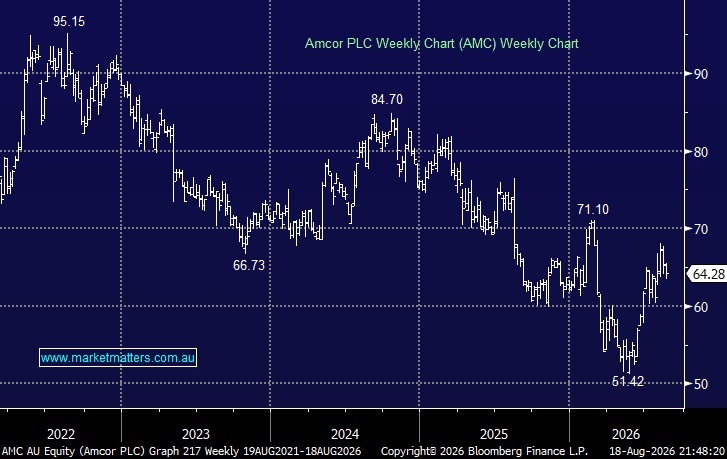
The pivotal Berry integration is running ahead of schedule, with AMC delivering ~US$285m of FY26 synergies, around 10% ahead of its initial target and already approaching half of its three-year US$650m goal. Higher input costs do remain a headwind, but pricing has largely kept pace, including ~US$280m of increases during the quarter – remember, before Amcor’s ~A$13bn all-stock acquisition of Berry, it was trading above $70, around 10% above yesterday’s close.
- The sticking point for AMC remains cash flow and leverage: FY26 free cash flow of US$1.3bn missed guidance, while Jul–Dec adjusted EPS guidance of US$1.80–1.90 was a tad softer than the market had hoped.
Overall, there was enough in the result to keep us bullish: Volumes have turned, synergies are arriving faster than expected, and pricing power remains intact, all of which strengthen the case for the Berry deal. Debt is a bit of a red flag for now, but management are focussed on deleveraging, and if they can do that at the same time as extracting the remaining synergies from Berry, the earnings story should improve materially into 2027, and beyond.
There are a couple of additional important points allowing MM to remain comfortably long this dual-listed packaging giant:
- It’s trading well below its long-term average valuation, yet the pivotal Berry integration is tracking ahead of initial targets – a refreshing outcome in large M&A land.
- AMC is forecast to yield 5.8% (unfranked) over the coming 12 months, making it fairly easy to give the position some time to return to pre-acquisition levels.
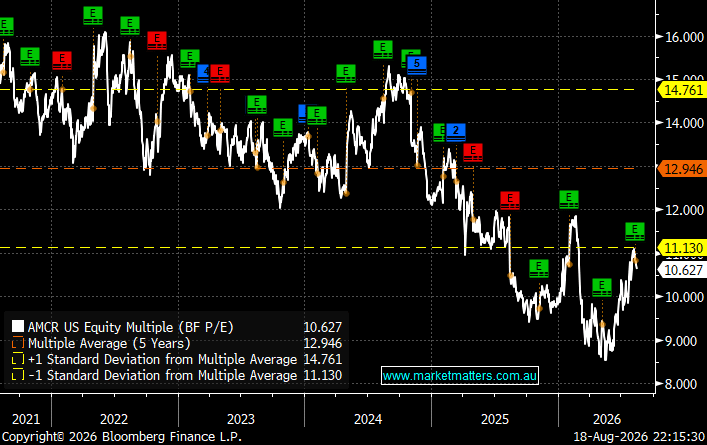
chart

Amcor (AMC) Historical Valuation P/E – Source Bloomberg
chart
Amcor (AMC) Historical Valuation P/E – Source Bloomberg
The other interesting aspect is that the market is split on AMC – some think it’s trading at too big of a premium to US peers and a free cash flow miss makes the premium hard to justify – we think that has some merit in the short term, but we also think it’s justified by synergy upside.
The Berry Global integration is clearly the centrepiece of Amcor’s earnings story, with management targeting US$650m of synergies by FY28, enough to drive more than 30% EPS growth over three years. Delivery is already running ahead of plan, while cross-selling opportunities are building and should increasingly complement the cost savings. Beyond Berry, the packaging company is reshaping the portfolio toward higher-growth, higher-margin categories such as healthcare, foodservice and pet care, while divesting non-core assets and reinvesting in capacity and R&D to lift organic growth.
- We believe AMC is delivering on the Berry integration across the metrics it can control.
The key question is whether underlying volumes can recover as the synergy tailwind builds. Recent volume weakness, elevated raw-material costs and softer cash conversion remain the main risks, while divestments create a near-term earnings drag. We believe Amcor can deliver the Berry synergies, restore organic growth and reduce leverage toward its 2.5–3.0x target; consensus expectations for high-single to low-double-digit EPS growth look achievable, and should ultimately provide the catalyst for a broader upside re-rating.
We are initially targeting the $70 area for AMC while patient shareholders will be rewarded with a solid yield along the way – we own AMC in our Growth and Income Portfolios.
MM remains long and bullish towards AMC around $64
Add To Hit List