Hi Geoff,
A fascinating question that illustrates some of the vagaries of ETF investing. Firstly lets compare the two ETFs which on the surface appear very similar:
Both ETFs provide exposure to large-cap US equities and use a covered call strategy to enhance income beyond what the underlying dividend yield would typically generate. They distribute income monthly and are aimed at investors prioritising cash flow over maximum capital growth, recognising that returns may lag during strong bull markets.
For Australian investors, the currency exposure is also broadly the same. Both funds are unhedged, meaning movements in the AUD/USD exchange rate can have a meaningful impact on returns, with a stronger Australian dollar acting as a headwind.
- Yield over the last 12-months: JEPI 7.38% and UMAX 5.38%.
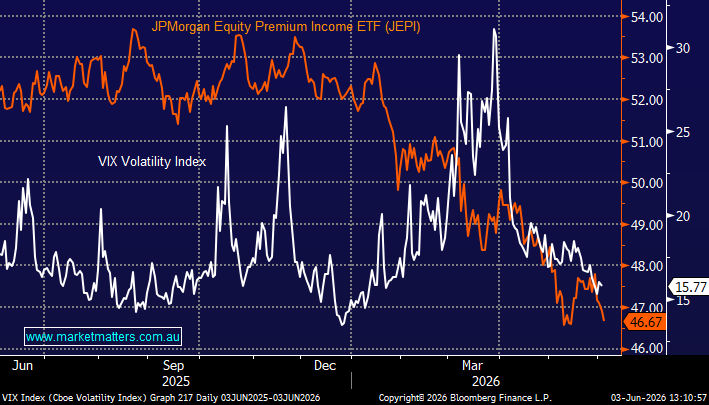
- Performance over the last 12-months: JEPI -3.6%, UMAX +12.1% and S&P 500 in AUD +16.9%.
- Fees: JEP 0.4% and UMAX 0.79%.
The mechanics of the 2 ETS are slightly but meaningfully different:
UMAX – holds S&P 500 stocks and systematically writes (sells) covered call options directly on the S&P 500 index.
JEPI — rather than selling call options directly, it uses Equity-Linked Notes (ELNs) — structured instruments issued by banks that embed the covered call exposure synthetically. The effect is similar, but the mechanism is different. JEPI also doesn’t hold the full S&P 500, it holds an actively selected subset of lower-volatility S&P 500 stocks chosen by JPMorgan’s portfolio managers, then overlays the ELN income strategy on top.
The JEPI through its “active management” has missed much of the concentrated gains in the S&P 500 with only ~7.5% exposure to Semiconductors at the time of writing, hence your selling calls over a high-flying index without holding much of the exposure that’s actually driven the US market. Conversely the UMAX holds ~19% in the high-flying semiconductors space.
- UMAX has been the far better-balanced income-plus-growth option in recent periods.