Skip to Content
scroll

The new Fed Chair.

Our Q&As are emailed in our Saturday Morning Report, find the answer to this question below.

The Latest Q&A

Question asked

The new Fed Chair.

Hi From what I've been reading it would seem that Trumps pick for the new Chair of the Fed, Kevin Warsh, isn't going to start slashing interest rates down towards 1% which, judging by his various comments in recent months, is where Trump has thought they should be. So why do you think Trump went for Warsh instead of just installing a puppet who would do what he told them to do when it came to setting interest rates? Do you think Trump (or his advisers) had a moment of clarity and decided that it was better for the Fed to maintain the appearance of independence after all? Does the fact that setting interest rates is a majority decision by the FOMC make it too hard for Trump to actually influence those decisions? Or have I missed something about Warsh and he's actually likely to be influenced by Trumps bullying tactics? Regards, Carl
Answer

Hi Carl,

Trump probably picked Warsh because he has genuine Fed credentials and strong market credibility, qualities that help avoid spooking bond markets, the dollar, and inflation expectations, and that also make Senate confirmation far smoother, while still choosing someone who has recently criticised the Fed and shown openness to easier policy, just not necessarily Trump’s “cut rates to 1% immediately” vision.

At the end of the day, the credibility of the  the Fed is very important for the U.S and their ability to borrow money, and Trump would recognise that.

Even if Trump instilled a chair who’d blindly comply, the chair can’t unilaterally set rates: the FOMC is a voting committee, and trying to force extreme cuts would likely meet internal resistance and blow up the Fed’s legitimacy. Hence we feel it’s less a “moment of clarity” and more a strategic compromise: pick someone aligned enough to push in your preferred direction, but credible enough to preserve the appearance (and some reality) of Fed independence—and Warsh is probably firm enough not to be bullied into obviously irresponsible cuts, even if he’ll be under heavy pressure.

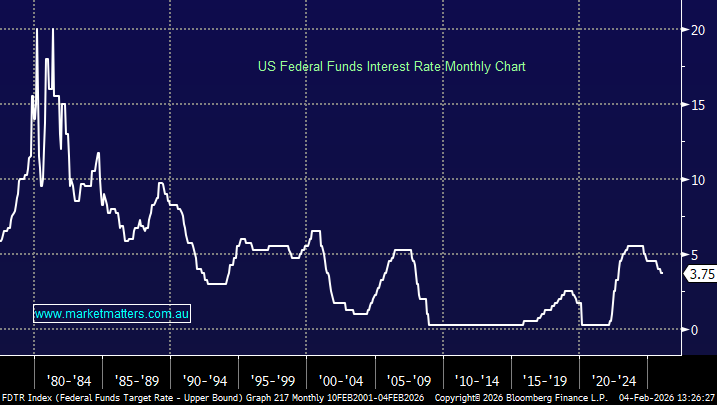
This question is very well timed after the RBA hiked rates 0.25% this week and US stocks experienced a sharp rotation into economically sensitive shares at the expense of AI related names. If the US economy is set to improve as sector rotation suggests further Fed cuts should be questioned in our opinion, especially the two 0.25% cuts being priced in by credit markets before Christmas – optimistic in our opinion, i.e. credit markets are pricing a Fed rate around 3% and an RBA rate above 4% which explains the recent strength in the $A.

chart
image description
US Fed Funds Target Rate
image description

Relevant suggested news and content from the site

Back to top