Hi Simon,
Firstly, we are happy to stick with (ASX:DN1) and (ASX:PCI) both of which still reside in our Active Income Portfolio, if/when this stance changes the positions will be assessed accordingly.
In terms of the 3 LITs, mentioned they all yield strongly but with proportional risk, a blend of the three would appeal to MM:
MA2HA (MA Credit Portfolio Notes): A unique hybrid concept as an ASX-listed security but with exposure to private credit underneath.
Pays monthly income of BBSW + 3.25% p.a., with a 5% co-investment “capital buffer” by MA Financial itself, to prioritise income and capital preservation. Exposure to a diversified portfolio of private credit investments:
1. Asset-Backed Lending (~80% of portfolio) Real-world loan portfolios — home loans, car loans, business loans, equipment finance. Lending against tangible assets rather than to a single corporate borrower.
2. Direct Corporate Lending (~20%) Loans to businesses with sensible leverage, cashflow, market position, and equity behind the debt.
The MA2HA note essentially tries to solve the liquidity problem of private credit — you get access via the ASX , but the underlying assets are still private loans. The trade-off is the yield (BBSW +3.25%) is lower than going direct into private credit, reflecting that liquidity premium.
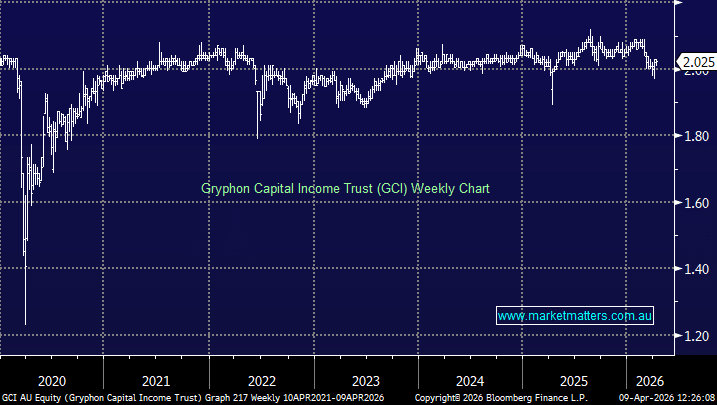
GCI (Gryphon Capital Income Trust): A structured credit LIT primarily investing in residential mortgage-backed securities (RMBS), providing income with exposure to Australian housing credit rather than corporate loans. One of the more established listed private credit vehicles on ASX. Senior secured focus, predominantly Australian with a decent track record. Targets RBA cash rate + ~3.5% currently. It yields ~7.8% (more defensive housing credit).
KIT (Kapstream Investment Trust): KIT is yet another response to investor demand for alternatives to bank hybrids, which are set to be phased out by APRA by March 2032. It aims to provide a reliable monthly income stream by investing flexibly across global bonds, private debt, and diversified credit opportunities – it targets RBA cash rate +3.5% p.a and estimated to yield ~6.5%. The portfolio will initially be built with about half allocated to the Absolute Return Income and Absolute Return Income Plus funds, and the balance in the Private Investment Fund.
KIT is an interesting product — a blend of liquid investment-grade global bonds and private warehouse financing, packaged into an ASX-listed structure with monthly income. In terms of its exposure, KIT is more diversified than pure private credit peers like MA2HA or GCI, which is both its strength and its limitation.
MM is broadly constructive on ASX-listed private credit but differentiates across MA2, GCI and KIT based on risk, structure and track record. MA2HA is solid given its scale, diversification and consistent income profile, supported by a strong manager in M A Financial. GCI offers a more defensive exposure through RMBS, with stable income but less upside, often trading at a discount. We like KIT for its diversified approach and the manager track record is strong, but would wait to see how the security trades from here, given it only listed 2 weeks ago (IPO 27 March 2026).
- We currently own: PCI, DN1, and are positive on MA1 & SPPHA (on weakness below par) & DMNHA.
We wouldn’t regard bank hybrids CBAPM, MQGPF, SUNPI, as private credit. Bank hybrids are debt securities issued by banks (with equity-like characteristics) that you can buy on a public market. Private credit is lending to companies (usually mid-market businesses) that don’t access public bond markets, arranged directly between lender and borrower, without going through a bank.
CBAPM, MQGPF and SUNPI are all bank hybrids (AT1 securities) offering yields in the ~6–7% range, with risk primarily driven by issuer quality and earnings volatility. CBAPM sits at the lower end of the risk spectrum given CBA’s strong balance sheet, resulting in a slightly lower yield, while MQGPF offers a higher yield to compensate for Macquarie’s more cyclical and market-exposed earnings profile. SUNPI sits between the two, with moderate risk tied to Suncorp’s smaller scale and insurance exposure. Overall, while they provide relatively attractive income, all three carry equity-like downside risk in stress scenarios due to their position in the capital structure.