Hi Tim,
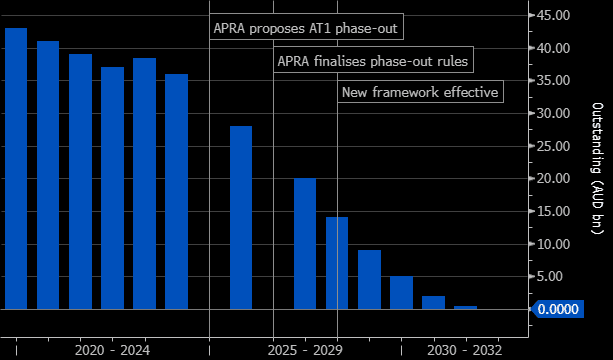
The ASX-listed bank hybrid market is in structural decline following APRA’s decision to phase out Additional Tier 1 (AT1) capital instruments entirely. Australia is the first country to eliminate the AT1 asset class from its banking capital framework. The chart below illustrates the expected rundown of outstanding volume through to 2032, when the market is expected to reach zero.
Investing for income becomes a relatively skinny playing field when we take stocks, hybrids and Private Credit (PC) off the table. This is becoming a real issue for Australian income investors. As bank hybrids disappear, there isn’t a perfect replacement offering the same combination of relatively high floating income, liquidity and franking. APRA itself acknowledged investors may migrate toward term deposits or Tier 2 capital, and banks will predominantly replace AT1 with Tier 2 regulatory capital. Existing bank AT1s are being progressively phased out through their first call dates, with the process completed by 2032.
- There is already a substantial listed fixed-income universe, one recent survey counted 78 ASX bond/fixed-income ETFs with ~$46bn under management.
With Australian 10-year government yields recently above 5%, traditional bonds are becoming a much more credible income alternative than they were when rates were near zero. Four alternatives are below:
- Floating-rate bonds: QPON-type exposure — low-to-moderate risk, with income that adjusts as interest rates change.
- Investment-grade corporate bonds: CRED, HCRD-type exposure — moderate risk, generally offering higher yields than government bonds.
- Tier 2 bank debt: Direct bonds or funds — moderate risk and arguably the closest structural replacement for bank hybrids.
- Government bonds: VAF, IAF or individual Australian Government bonds — low credit risk, providing regular income plus potential capital gains if bond yields fall.
This question could easily be a MM morning note in itself but keeping an eye on our Income Portfolio will give the best indication on our thoughts moving forward.