Hi Darren,
An excellent and well-timed question as we weigh up the implications of the recent Budget, and local employment/CPI economic data which have reduced the chances of multiple rate hikes in 2026.
The concerns being raised are legitimate.
MGR and SGP do have more residential exposure than most A-REIT peers. MGR in particular carries a meaningful development pipeline across master-planned communities and apartments, which naturally makes earnings more cyclical than a pure-play logistics or commercial REIT such as Goodman or parts of Charter Hall. If the housing market weakens significantly whether through affordability pressures, sticky intertest rates, softer population growth or a pullback in buyer confidence, MGR’s earnings would likely feel that impact more directly.
However, the big question is around valuation.
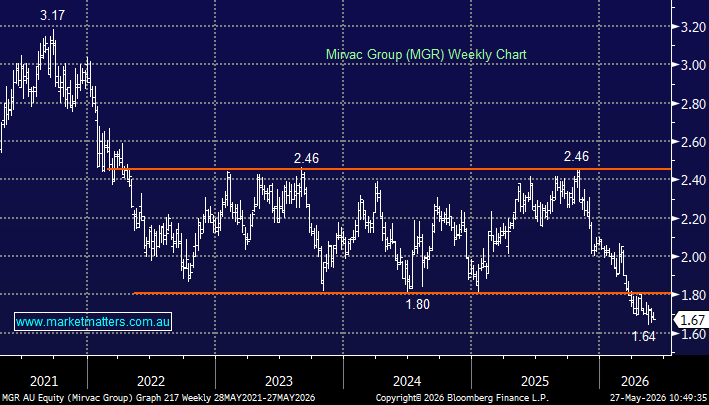
MGR has underperformed both the broader REIT index and the ASX200 in 2026. The housing slowdown concerns has been widely discussed and heavily debated for some time; it’s not a “Black Swan” risk.
- Mirvac is already trading ~20% below its long-term valuation illustrating there’s plenty of bad news baked into the cake.
We remain constructive on MGR at current levels, but with eyes open. This is not a “set-and-forget” defensive REIT exposure — it’s a risk/reward call where we think a reasonable amount of bad news is already embedded in the share price. At this stage, most analysis we read suggest housing prices could pull back by 2-6% – noting, these are notoriously hard to predict.
If the housing cycle deteriorates materially beyond expectations, MGR is likely to continue to underperform the ASX, and note, at this stage we have no interest in increasing our exposure to the Australian Housing market, it’s one of the reasons we are comfortable being underweight the “Big Four Banks.’
On SGP, the setup is similar but with a slightly different mix but both stocks are likely to move in the same direction around property prices, so far in 2026 Mirvac is down 18% and Stockland 30% illustrating the latter’s likely to be more sensitive to property prices and economic conditions, in both directions.
Of more importance for these stocks is bond yields. From October 2025 to now, the Australian 3-year yield has moved from 3.2% to 4.5% (having peaked ~4.70%). That move pushed Mirvac from $2.45 – around the area we sold our last position, down to $1.65 last week. The correlation with bond prices (inverse of yields) is very high. We continue to believe that bond yields will by the primary driver of property stocks in the coming months. As bond yields peaked, both Mirvac and Stockland share prices have bottomed.