Hi Manjeet,
Pro Medicus (PME) would be an ASX listed MedTech company to look at – we own this in the Growth Portfolio, but if you are more focused on the sector overall, an ETF is potentially best. Looking towards the US is where the depth of MedTech companies are, so below are two US listed offerings.
Two alternatives which come to mind are:
iShares US Medical Devices ETF (IHI US) – this ETF tracks the Dow Jones U.S. Select Medical Equipment Index, providing exposure to U.S. companies that manufacture and distribute medical devices including imaging equipment, prosthetics, and surgical instruments. Its largest holdings include Intuitive Surgical, Abbott Laboratories, Boston Scientific, Stryker, and Becton Dickinson, making it a concentrated pure play on the medical devices sub-sector rather than broader healthcare.
Vanguard Health Care ETF (VHT US) – this ETF tracks the MSCI US Investable Market Health Care 25/50 Index, offering broad diversified exposure across the full US healthcare sector including pharmaceuticals, biotechnology, medical devices, and managed care. With over 400 holdings and a low expense ratio, it is one of the largest and most cost-efficient healthcare ETFs available, with top positions in Eli Lilly, UnitedHealth Group, Johnson & Johnson, AbbVie, and Merck.
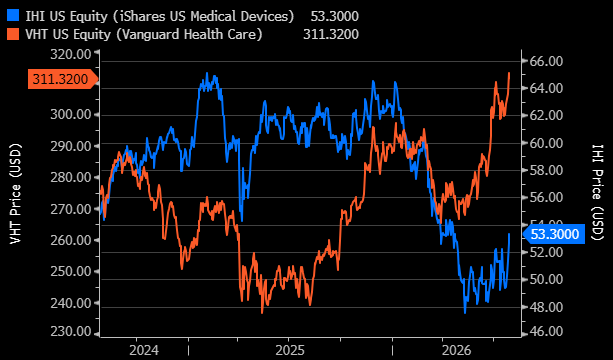
The performance of the 2 ETFs depends on the timeframe considered although the VHT comes out on top:
Over the past 10 years, both ETFs have generated strong long-term returns, but VHT outperformed IHI by more than 30% (+160.8% vs +130.1%). VHT’s broader healthcare exposure benefited from the GLP-1 pharmaceutical boom and strength in managed care, while IHI’s narrower focus on medical devices still delivered solid long-term compounding.
The contrast is more pronounced over five years, with VHT up 30.7% versus IHI down 14.4%. Medical device stocks have faced several headwinds since 2021, including higher interest rates compressing valuations, concerns that GLP-1 drugs could reduce demand for some procedures, and a slower-than-expected recovery in post-pandemic surgical volumes.