Hi Sean,
This is a good question, and we’re sure you are not the only one thinking about this.
Firstly, on the liquidity front there’s a large difference between low turnover and depth – when we show volume in the screen, it will often get hit but you are correct, there is an added risk compared to some investments that enjoy large bids & offers on the screen. The lack of depth in the screen can cause outsized moves in these sorts of securities, both on the downside and upside, so being disciplined on price is important. The covid experience was a good example of this, but arguably, this is more an opportunity than a risk in these sorts of securities, particularly ones with a defined call/maturity date. Also, if moving decent volume, a broker can assist by finding buyers/sellers in these types of securities that are not showing up in screen.
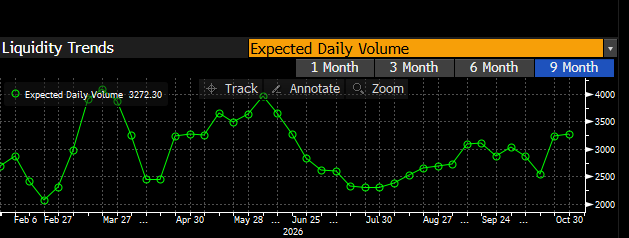
DN1 has 3.45m units on issue with a market cap of $345m. Expected daily liquidity is 3272 units (as shown below), or ~$320k. That needs to be considered when thinking about the size of position held.
- When we do buy & sell positions such as DN1, we go slowly and carefully.
In terms of how the call date works, Realm (which is the owner of Dominion) plans to call the security on 27 February 2030, but they can push that out to the contractual maturity date of 27 February 2031. If Realm does not call the note in February 2030, the distribution margin increases by 1% p.a. for the final year.
At February 2031 maturity, they are contractually required to redeem outstanding notes at face value plus accrued unpaid interest. Under Section 2.6 of the PDS, failure to repay principal or interest due on 27 February 2031 triggers a winding up event. The portfolio is made up of securities with similar sorts of protections, mainly of residential mortgage-backed securities (RMBS) and asset-backed securities (ABS) with some privately negotiated credit facilities, with relatively short maturity profiles.
DN1 trades at a ~2% discount to its NTA, which is small relative to others in the sector. We are confident that buying now will provide investors with a solid ~8% yield + a small amount of capital upside back to $100 redemption price, but there could well be volatility along the way because of buying or selling pressure on the market, but that doesn’t change the safety or otherwise of the security, as long as the intention is to hold until the contracted maturity date.