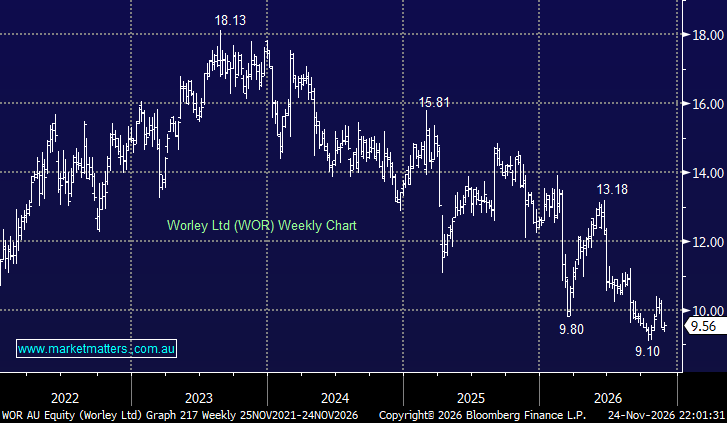
WOR has been one of MMs most frustrating positions in our Active Growth Portfolio, despite much of the reasoning to purchase the global engineering company having played out. The stock has continued to disappoint; one standout characteristic we’ve noticed in 2026 is how the share price doesn’t react to contract wins compared to, say, another holding, Pro Medicus (PME), which often pops 5-10% when it lands a new contract, with the market simply not believing the engineering firm can convert the business into profit.
- WOR operates on low margins, with an improvement here to cornerstone of our investment thesis. Improving margins on a growing revenue line would have a material positive impact on profits, however, this has proven easier said than done, particularly given their large exposure in the Middle East with the war delaying projects and increasing operating costs in that region.
It’s been a tough period for WOR over the last 3 years with a succession of earnings disappointments, restructuring costs, Middle East project delays and weakening confidence in management’s ability to convert its substantial project pipeline into better earnings. While earnings have actually increased by ~20% since early 2023, Worley’s forward P/E multiple has contracted by more than 40%, from around 21x to around 11x today. In other words, the market is increasingly questioning the quality, visibility and reliability of future earnings.
Several events have contributed to that loss of confidence in WOR; it felt like a death by a thousand cuts, including the $240m loss on the sale of its North American maintenance business in FY23, unexpectedly high restructuring costs in FY26, the escalating financial impact of the Middle East conflict and disappointing FY27 growth guidance of mid-to-high single digits, versus market expectations of around 15%.
The medium-term investment case rests on the ramp-up of the CP2 LNG project, a potential recovery in Middle East activity and management’s ambition to deliver double-digit underlying EBITA growth between FY26 and FY30. However, near-term risks remain, particularly currency movements, delayed project awards and a heavily back-ended FY27 earnings profile, with around 60% of earnings expected in the second half. Management’s growth ambition is encouraging, but profitable deliver is the key.
- Theoretically, an improved situation between the US and Iran, and the A$ trading well under 67c should provide a tailwind for WOR who enjoy more than 90% of earnings from overseas.
Worley is now cheap, trading 30% below its 5-year average PE, but cheapness alone is not a reason to buy or hold a stock; many stocks stay cheap for a long time only to ultimately disappoint again, showing investors why they were cheap in the first place.
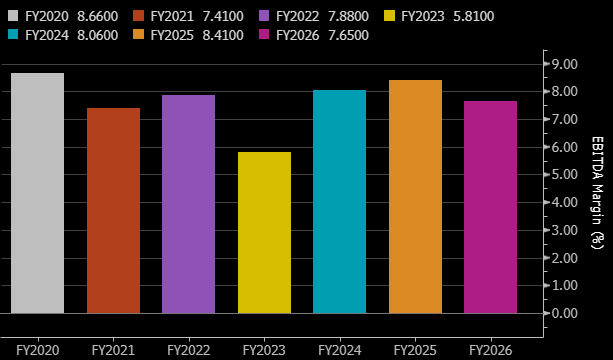
The trend in earnings revisions is important for share prices. MM, and the market collectively, had become optimistic on their forecasts as they increased their exposure towards higher margin decarbonisation work relative to lower margin maintenance, but ultimately, this has proven slower than originally thought. Earnings estimates have been cut by ~37% from their peak, and the multiple the market pays for those earnings has been cut by ~50%, together explaining the bulk of the share price decline from 2023 highs. The chart below shows that after collapsing to 5.8% in FY23 (driven by the Jacobs integration loss), margins recovered to 8.4% in FY25 but then fell back to 7.7% in FY26 as restructuring costs and Middle East disruptions hit. Investors had priced in a sustained margin recovery that has not yet materialised.
chart

Worley (WOR): EBITDA Margin- Source: Bloomberg
chart
Worley (WOR): EBITDA Margin- Source: Bloomberg
Looking ahead, the downside risks are largely known and at least partly priced in, with Worley trading on a six-year low earnings multiple. On balance, we see a more favourable risk/reward profile, with potential upside from CP2 LNG, restructuring benefits and growing demand for energy transition and data-centre infrastructure.
- If we had no position in WOR, we would be targeting it as a potential turnaround story, but we’re just not seeing any tangible evidence of that yet, prompting the question, should we continue to remain patient, or recycle the capital elsewhere, and revisit at a later date?
MM is neutral towards WOR around $9.50
Add To Hit List