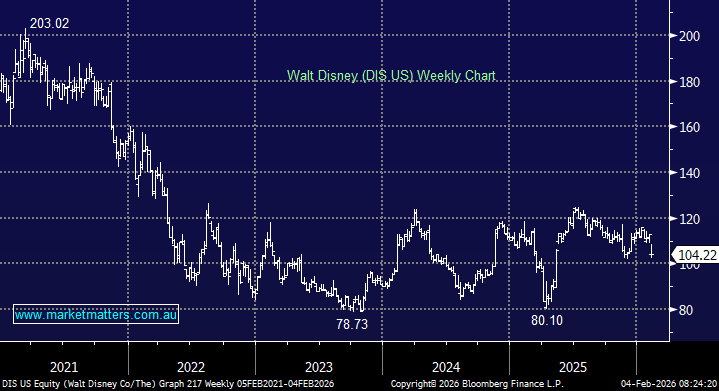
DIS US shares fell ~7% following their quarterly results released this week despite a modest earnings beat, as investors looked through the quarter and focused on softer near-term guidance, rising sports rights costs and limited visibility around parks growth.
- Adjusted EPS: $1.63 (vs $1.56 expected; $1.76 YoY)
- Revenue: $25.98bn, +5.2% YoY (vs $25.69bn expected)
- Total segment operating income: $4.60bn (vs $4.59bn expected; -9% YoY)
- Entertainment: Revenue $11.61bn (+6.8% YoY); OI $1.10bn (-35% YoY)
- Sports: Revenue $4.91bn (+1.2% YoY); OI $191m (-23% YoY)
- Experiences: Revenue $10.01bn (+6.3% YoY); OI $3.31bn (+6.4% YoY)
Experiences again did the heavy lifting, delivering record revenue and solid profit growth, but management flagged only modest growth in the March quarter due to weaker international visitation to US parks, cruise-launch costs and pre-opening expenses at Disneyland Paris. Growth is expected to be back-half weighted.
Entertainment remains the key swing factor. While streaming profitability improved sharply, divisional earnings fell on lower political advertising and elevated marketing spend tied to major film releases. Management guided to flat YoY operating income in Q2 despite continued streaming improvement.
Sports (ESPN) continues to face structural margin pressure, with higher rights costs and a temporary YouTube TV carriage dispute weighing on results. Disney guided to a further ~$100m QoQ decline in sports operating income next quarter.
- Overall, their FY outlook was left intact, with Disney targeting double-digit EPS growth and high-single-digit experience income growth, both weighted to the second half, implying a longer-dated recovery than the market was unwilling to wait for.
We’ve owned Disney in the past but not for a few years, and the stock is trading only mildly above the level we sold it back in late 2023. While we continue to like some parts of their business, there always seem to be areas that are grappling with headwinds – in this result it was sports impacted by rising costs. Our positive view historically revolved around streaming, and their decision to create their own platform rather than provide content for others. A more costly approach, but one if executed well, would yield better returns over time. That is starting to play out, however not to the extent that it can offset weakness elsewhere.
For a business of this scale and quality, an Est PE of 15.8x for FY26 is not too daunting, though it’s unlikely that growth will pick up until later in 2026 /early 2027 where structural changes made in prior periods under outgoing CEO Bob Igor should bear fruit. The board announced plans to name Iger’s successor in early 2026 ahead of his scheduled departure at the end of 2026, with Josh D’Amaro, the current Chairman of Disney Experiences the most likely replacement.
- This is a stock to keep on the radar, but it seems too early for now.
MM is neutral DIS US ~$US104
Add To Hit List