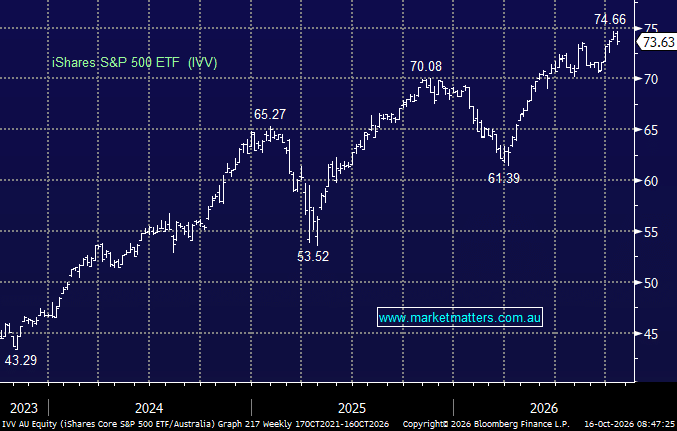
The IVV ETF remains one of the simplest and most cost-effective ways to gain exposure to US equities, but we’re increasingly questioning whether it’s the best way to invest in the US market at this point in the cycle. Today, the 10 largest holdings account for ~40% of IVV, with Nvidia (~8.2%), Apple (~7.4%) and Microsoft (~6%) alone representing more than 21% of the ETF. Sector concentration is equally high, with Information Technology accounting for around 40% of the index, rising to almost 60% when Communication Services and Consumer Discretionary are included – sectors which house other technology-driven giants such as Alphabet, Meta, Amazon and Tesla. In other words, while buying IVV is technically buying exposure to 500 companies, a relatively small group of mega-cap technology names are doing much of the heavy lifting.
To put this into perspective, the top 10 stocks represented just ~19% of the S&P 500 in 2015, compared with over 40% by the end of 2025, more than doubling in a decade. Even at the peak of the dot-com bubble in 2000, the largest 10 companies represented only ~27% of the index. Today’s level of concentration is extraordinary by modern historical standards.
- Nvidia alone now carries more than four times the weight of the entire Energy sector, while the three largest technology companies collectively outweigh Financials and Industrials combined. That’s a significant concentration of risk for an ETF often viewed as a broadly diversified core holding.
Importantly, we aren’t suggesting the US technology giants are necessarily heading for a prolonged period of underperformance. Their earnings growth remains fantastic, and many are likely to remain long-term winners from the AI revolution. However, after years of outperformance which has led to increasingly crowded positioning, plus recent weakness in semiconductor stocks, suggests the risk/reward is becoming less compelling relative to other areas of the market.
For MM, we believe now is a good time to consider broadening equity exposure rather than simply adding to the traditional market-cap-weighted S&P 500. If US bond yields pullback, we expect the rally to broaden into more economically sensitive sectors and companies that have largely been left behind, and there are better ways to play that theme than the IVV.
MM prefers less concentrated ETFs than the IVV
Add To Hit List