SiteMinder’s FY26 result yesterday was disappointing, with misses across revenue, Average Reoccurring Revenue (ARR) and EBITDA, but the bigger issue for us is the change in the growth narrative. SDR has spent the past few years positioning itself as a 30% growth business; that ambition has now effectively been retired, with management guiding to ARR growth of 20–29% in FY27 and an ARR CAGR “in the 20s” through FY30. For a growth stock, stepping back from previously stated growth ambitions is not a good development.
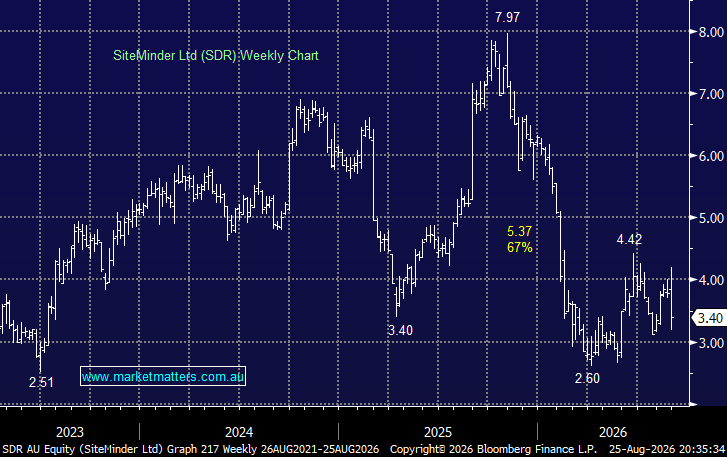
The stock has already been weak, down around 36% YTD heading into the result, so expectations had clearly been reset to some degree. Even so, the market was unimpressed, with SDR falling around 11% yesterday to $3.40 after trading as much as 17% lower intraday.
Key results:
- Revenue $266.1m, +18.6% YoY but 2.5% below consensus of $272.9m
- Closing ARR $313.7m, +24.1% on a constant-currency basis and 2.2% below consensus of $320.9m
- Adjusted EBITDA $28.1m, almost doubling YoY versus $29.5m expected
- Reported net loss $11.3m versus consensus for a $4.7m loss
- Adjusted free cash flow $10.5m, more than doubling YoY, but below expectations
There are some positives within the numbers. Transaction ARR grew a strong 37.1% to $110.9m, subscription ARR increased 15.1% to $169.4m, adjusted EBITDA margins expanded to 10.6%, and cash generation continued to improve. However, those improvements are being overshadowed by a clear deceleration in the headline growth rate.
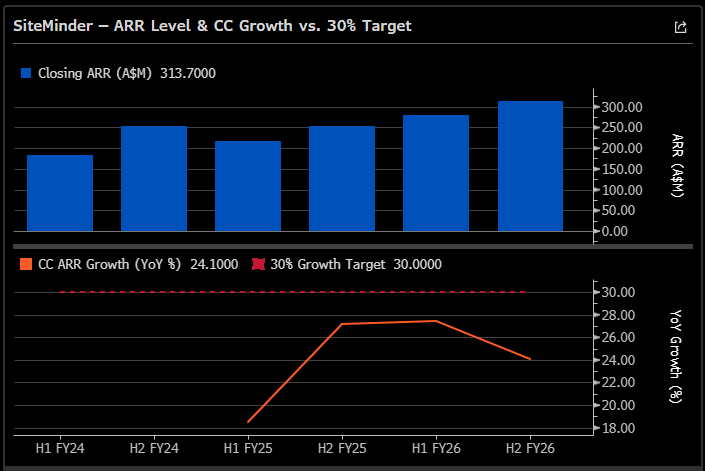
SiteMinder previously targeted around 30% organic annual growth, but ARR growth has consistently fallen short of that mark. It recovered to around 27% through H2 FY25 and H1 FY26 before slowing again to 24.1% in FY26. Management has now replaced the 30% target altogether with FY27 ARR growth guidance of 20–29%, while saying growth through FY30 should compound “in the 20s”.
chart

SiteMinder ARR (top) and recent growth rates (bottom) – source Bloomberg
chart
SiteMinder ARR (top) and recent growth rates (bottom) – source Bloomberg
The offset is profitability. SDR expects adjusted EBITDA margins to “expand meaningfully” in FY27 and is targeting a mid-20s EBITDA margin by FY30. That gives management another lever to create value, and a greater emphasis on operating leverage and cash flow is sensible as the business matures. But the FY27 guidance is vague, and there is no hard near-term margin target to compensate investors for the lower growth ambition.
MM’s view: We own SDR and this result is below our expectations. The misses themselves are manageable, particularly given how weak the stock has already been, but the reset to the growth ambition is more significant. Growth companies are generally afforded premium valuations because investors believe they can sustain superior rates of expansion; when management steps away from that promise, the market quite rightly asks what multiple it should now pay.
We still see a good business here, with a strong position in hotel technology, attractive transaction growth and improving operating leverage, but management now needs to prove that growth in the 20s can be accompanied by much stronger margins and cash generation. We’re not inclined to panic after the recent weakness, although the investment case has clearly become less compelling today and we need to see execution improve from here.
MM now has SDR on watch ~$3.40, more inclined to cut on lower growth expectations
Add To Hit List