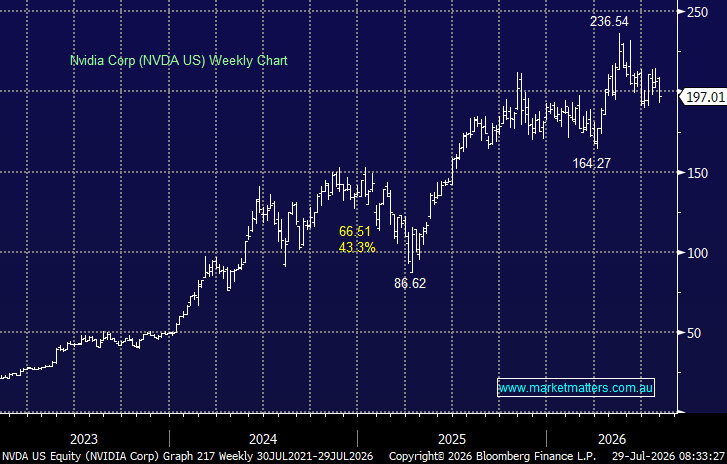
With Nvidia trading around US$195, it sits near the midpoint of its 12-month range, suggesting the market retains some doubts about its outlook. Today, we consider where those concerns are coming from and whether they have merit. In other words, what is the bear thesis on the world’s largest company?
Firstly, Nvidia remains the undisputed leader in artificial intelligence hardware, and its recent financial performance has been extraordinary. First-quarter revenue surged 85% to US$81.6 billion, including a 92% increase in Data Centre revenue to US$75.2 billion, while gross margins remained around 75%.
- The bear case is therefore not that Nvidia is a poor business. Rather, it is that the market may already be pricing in an exceptionally favourable future.
The company is now valued at approximately US$5 trillion, meaning Nvidia must continue delivering enormous earnings growth simply to justify its current size. At these levels, strong results may no longer be enough. Revenue growth must remain exceptional, margins need to stay elevated, and the AI infrastructure spending cycle must continue with few interruptions. Any moderation in these assumptions could lead to a meaningful valuation contraction, even if earnings continue to grow.
The major risks include:
- A slowdown in hyperscaler spending: Nvidia is benefiting from an unprecedented data-centre buildout by Microsoft, Amazon, Alphabet, Meta and other major customers. However, these companies will increasingly need to demonstrate that hundreds of billions of dollars in AI investment can generate acceptable commercial returns. If monetisation falls short, capital expenditure could be deferred or reduced, leaving Nvidia exposed to a sharp slowdown in incremental demand.
- High customer concentration: Nvidia remains heavily dependent on a relatively small group of very large technology companies. This gives its largest customers a powerful incentive to reduce their reliance on Nvidia over time. Amazon, Google and Microsoft are all developing custom AI accelerators, while AMD and a growing number of specialised semiconductor businesses are targeting parts of the market. Nvidia’s CUDA software ecosystem remains a formidable competitive advantage, but the economics are attractive enough to ensure customers and competitors continue investing heavily in alternatives.
- Rapid product cycles: Nvidia is moving quickly from Hopper to Blackwell and then Rubin, delivering significant improvements in performance and inference costs. While this reinforces its technological leadership, it also shortens product cycles and increases the risk that customers delay purchases ahead of new releases. It may also accelerate the depreciation of existing infrastructure, challenging the economics of the enormous investments currently being made.
- Increasing financial involvement in the AI ecosystem: Attention this week has focused on Nvidia’s potential role in supporting broader AI infrastructure investment. Reports that it could provide substantial guarantees or financing connected with new OpenAI data-centre projects have raised concerns about increasingly circular demand, where Nvidia helps finance customers that ultimately use the capital to purchase Nvidia chips. These arrangements may never proceed in their reported form, but they highlight the sheer amount of funding required to sustain the current AI buildout.
- Geopolitical constraints: US export controls restrict Nvidia’s ability to sell its most advanced products into China, while also encouraging Chinese companies and policymakers to accelerate the development of domestic alternatives.
- Pressure on margins: Nvidia’s gross margins of approximately 75% are exceptional for a semiconductor company and reflect a period in which demand has materially exceeded supply. As supply improves, competition intensifies and customers develop alternatives, pricing power and margins could moderate. Even a relatively modest decline in margins would have a meaningful impact given the expectations embedded in the share price.
At its current valuation, we believe some of these concerns are already reflected in the price. However, it is important to stress that the bear case does not require the AI boom to end. It simply requires growth to slow, customers to become more disciplined, competition to increase or margins to moderate. Nvidia could remain the dominant AI semiconductor company and still deliver disappointing shareholder returns if earnings fail to keep pace with the expectations already reflected in its valuation.
We continue to regard Nvidia as one of the world’s highest-quality technology businesses. However, at its current size, the risk/reward is increasingly dependent on the AI investment cycle remaining stronger for longer. The larger Nvidia becomes, the harder it is for incremental growth to move the dial, and the less room investors have for disappointment.
At MM, we always consider both the bull and bear cases for stocks we are interested in. While we still believe the bull case for Nvidia carries greater weight, the recent panic style pullback across the semiconductor sector, combined with Nvidia’s continued dominance, means we, and investors more broadly, should consider what could go wrong before initiating a position.
- We like NVDA over the medium term, but in the current volatile environment we wouldn’t be surprised to see the stock retrace towards the US$170 level, particularly around its August earnings. Remember, the current reporting season has shown that even US technology companies beating expectations have often been sold off, highlighting some underlying concerns percolating within the sector.
MM remains cautiously bullish NVDA US ~$US200
Add To Hit List