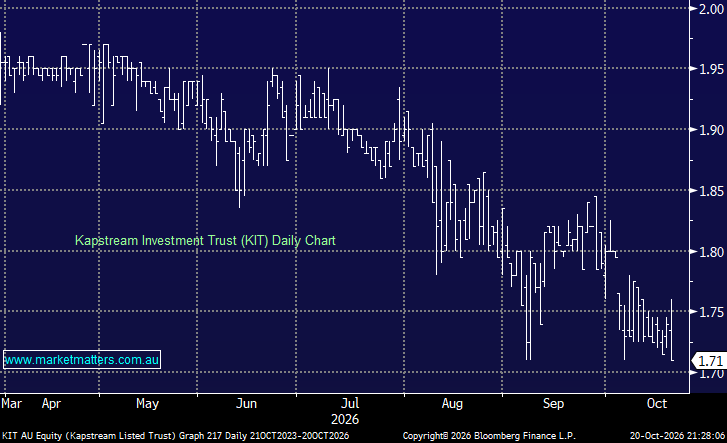
Kapstream Investment Trust (ASX: KIT) $1.71 vs Metrics Master Income Trust (ASX: MXT) $1.665
We wrote recently about Metrics Master Income Trust (MXT) following significant selling pressure across the listed private credit sector. Our conclusion was that MXT was becoming increasingly interesting, with its unit price now more adequately reflecting the risks within its underlying loan book. However, having looked more closely at the various credit-focused Listed Investment Trusts (LITs) trading on the ASX, Kapstream Investment Trust (KIT) stands out as a potentially more attractive alternative.
At $1.71, KIT trades at a 14.3% discount to its net tangible assets (NTA), offering a running distribution yield of 9.4%. MXT, meanwhile, closed yesterday at $1.655, representing a 15.6% discount to its latest NTA of $1.96, also offering a running yield of approximately 9.4%. Both look interesting at these levels, but there are some important differences in their underlying portfolios.
The key attraction of KIT is its portfolio composition. Around 52% is invested in warehouse financing, including residential mortgages (34%), automotive loans (8.5%), consumer lending (7.4%) and medical lending (2.1%). Warehouse facilities are generally considered lower risk relative to direct property lending, as they’re backed by diversified pools of existing, income-producing loans, rather than relying on the successful completion and sale of individual property developments. This reduces single-project concentration and avoids many of the construction and completion risks associated with development lending.
Direct construction lending accounts for just 2% of KIT’s portfolio, a significant distinction from property-heavy private credit funds such as MXT, where ~60% of the loan book is exposed to real estate, comprising 35% in real estate management and development and 26% in REITs. Importantly, not all of MXT’s property exposure is construction lending, with loans to established property owners generally carrying different risks from financing individual developments.
The balance of KIT’s portfolio includes senior unsecured bonds (17.2%), asset-backed securities (9.6%), Lower Tier 2 debt (5.9%), mortgage-backed securities (4.6%), senior secured debt (3.3%) and other exposures, providing diversification across borrowers, asset classes and credit markets.
From a credit perspective, around 68% of KIT’s portfolio is investment grade, with an average rating of BBB, and around 83% of its investments are floating rate, reducing sensitivity to movements in underlying bond yields. The portfolio is spread across 83 issuers and 212 individual securities, with an underlying yield to maturity of 9.22%, up from 6.79% in March as the portfolio has evolved.
The underlying warehouse credit metrics are also encouraging. Average mortgage loan-to-value ratios (LVRs) are approximately 68%, with average subordination protection of 20%. Underlying loan losses over the preceding 12 months were just 0.08%, while losses on the warehouse notes themselves were zero. At the end of August, KIT also reported no defaulted investments, no watchlist exposures and no investments currently paying interest in kind (PIK). While these are positive indicators, KIT has only been listed since March, and the performance of its underlying credit exposures through a more difficult economic environment remains has not been tested.
There is, however, an important trade-off. Around 58% of KIT’s credit exposure sits in mezzanine or junior-ranking securities, which are more exposed to losses if underlying borrowers default. While these investments benefit from collateral backing and structural protections, KIT is not a conventional low-risk bond portfolio. Its higher yield reflects the additional credit, liquidity and structural risks being assumed. We would also highlight that a meaningful proportion of its investment-grade exposure is internally rated, rather than independently assessed by external rating agencies.
This is where the comparison with MXT becomes interesting. While MXT has a lower investment-grade allocation of ~44% and significantly greater exposure to property lending, around 97% of its portfolio comprises senior-ranking loans. This provides greater contractual repayment priority in the event of borrower difficulties, although recoveries ultimately depend on the value of the underlying security.
In other words, KIT offers greater diversification away from the Australian property development cycle, while MXT benefits from stronger loan seniority. Neither is necessarily lower risk overall; they simply take different types of credit risk. One area where we remain more cautious on MXT is the deterioration in parts of its loan book. At the June quarter, six loans representing 3.8% of portfolio assets were under enforcement, up from 2.5% in March. While enforcement does not necessarily translate into realised losses, it warrants monitoring, particularly given MXT’s significant commercial property exposure. NB: Its August update did not provide an refreshed enforcement figure.
In terms of valuation, both trusts are trading at discounts of around 14–16% to NTA, with running yields above 9%. At KIT’s current price, investors are effectively purchasing approximately $2.00 of underlying assets for $1.72. If confidence in the sector improves and the discount narrows to 5%, this would imply around 11% capital appreciation before distributions, assuming the NTA remains unchanged. KIT’s recently announced on-market buy-back of up to 5% of units on issue could also provide some support, although there is no guarantee the discount will narrow.
Ultimately, we believe the sell-off across listed credit is creating opportunities for investors prepared to look beyond the negative headlines, although, we have not made any changes in this space yet. Both KIT and MXT offer attractive income and the prospect of capital appreciation if discounts narrow, although the underlying credit risks should not be underestimated.
Ultimately, we favour KIT relative to MXT at current prices, primarily because of its more diversified underlying collateral, substantially lower direct exposure to property development lending and encouraging underlying loan performance. While KIT’s mezzanine and junior exposures introduce meaningful risk, we believe its current discount and income provide reasonable compensation.
- For investors seeking exposure to listed credit while reducing reliance on the Australian property development cycle, KIT looks the more attractive relative-value opportunity, in our view.