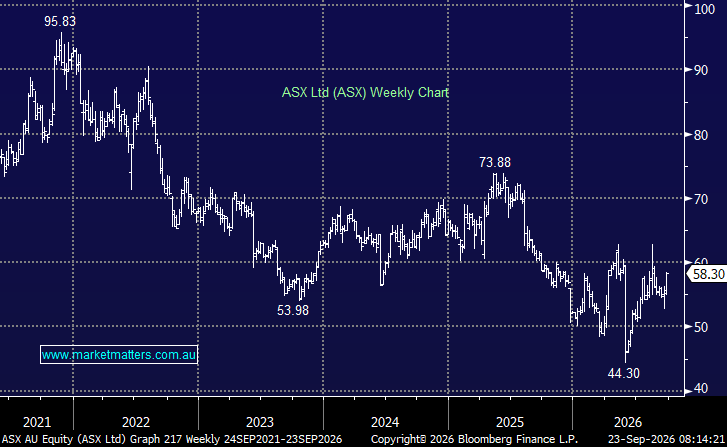
ASX has been a poor performer over the past 4 years, down ~40%, and much of the damage has been self-inflicted. The failed first attempt to replace CHESS, ballooning technology spend, rising costs and increased regulatory scrutiny have steadily eroded confidence in what should be one of Australia’s highest-quality financial infrastructure businesses. But after years of disappointment, there are signs the worm may finally be turning.
The shares rallied on the FY26 result, but like many stocks in Australia, they have pulled back since, yet the underlying business has actually started FY27 strongly. Futures volumes, which account for around a quarter of group revenue, were running 31% higher year-on-year through mid-September, versus consensus expectations for just 10% growth in 1H27. Cash equity turnover was also up 9%, ahead of the market’s 6% assumption.
We’ve written recently about the trend of increasing automation in trading. Quantitative strategies, systematic funds, algorithmic execution and high-frequency traders can generate significantly more transactions than traditional discretionary investors, particularly as portfolios are rebalanced, arbitrage opportunities are exploited and orders are broken into smaller pieces and executed electronically. This doesn’t necessarily mean more dollars are being invested in equities, but it can mean more trades passing through market infrastructure, and that’s important for an exchange operator like ASX.
ASIC’s latest data shows just how transaction-heavy the Australian market has become. There were around 3.8 million equity trades per day in the June 2026 quarter, while ASX itself accounted for almost 84% of Australian equity-market dollar turnover. ASX’s own data also shows monthly equity trades rising from roughly 44 million in June 2025 to 67 million in June 2026, with July and August running above 60 million.
High-frequency trading is only one part of that shift, and the latest detailed ASIC work on HFT is older, so we wouldn’t suggest HFT alone is driving the current surge. But ASIC has previously found high-frequency participants accounted for roughly a quarter of Australian equity turnover and a disproportionately high share of orders and trades, while also contributing liquidity to the market.
More electronic trading, more systematic strategies and more frequent portfolio rebalancing can support transaction volumes even without a corresponding boom in traditional investor activity. This looks to be an underappreciated long-term tailwind for a business whose economics are tied, in part, to activity rather than simply the direction of the sharemarket.
Importantly, ASX doesn’t need the current pace of growth to continue. After the strong start to FY27, the hurdle embedded in consensus forecasts looks relatively low. For the first time in a while, earnings risk may be shifting to the upside rather than the downside.
Ironically, the significant investment required to fix and replace CHESS – one of the main reasons investors have been frustrated with ASX – is increasing the regulated asset base and therefore supporting higher allowable revenues. On UBS numbers, the clearing, settlement and issuer-services revenue cap could increase by almost 20% in FY27, from $237m to around $284m.
- Taking a step back, for several years, ASX has been a story of rising costs offsetting otherwise attractive revenue growth. That hasn’t disappeared – FY27 remains another heavy investment year – but we’re starting to see a path towards earnings growth becoming more visible.
UBS currently expects FY27 EPS of around $2.72, increasing to $2.78 in FY28 and $3.01 in FY29. More interestingly, its forecasts are roughly 4% above consensus for FY27 and nearly 10% ahead by FY29. The divergence grows over time because UBS expects stronger Markets and Securities & Payments revenue than the market currently assumes. Importantly, ASX doesn’t necessarily need heroic growth, it simply needs the business to stop disappointing.
If trading activity remains healthy, clearing and settlement revenues increase under the new regulatory framework and the rate of cost growth eventually normalises, the earnings profile starts to look materially better.
Historically, ASX was rarely bought primarily for income because investors paid a substantial premium for its quality and monopoly-like characteristics, but that premium has largely disappeared.
At around $58, ASX is trading on roughly 22x forward earnings, around 6% below its 10-year average multiple. Relative to the ASX 200, its P/E premium has also fallen, with the stock trading at around 1.3x the market versus a long-term average closer to 1.6x.
At the same time, the dividend yield has moved towards 4% fully franked, above its 10-year average of around 3.4%, and now above 5% when including franking.
Again, using UBS estimates here, they forecast dividends of $2.11 in FY27, $2.22 in FY28 and $2.41 in FY29, suggesting we could see both a reasonable starting income stream and some dividend growth if earnings recover as expected.
- Important to note that costs are still elevated and execution risk hasn’t disappeared, so we wouldn’t suggest the turnaround is complete, but the setup is becoming more interesting.
For income, the ~4% fully franked yield isn’t enough on its own to make ASX an outright buy, but when we think about the yield in addition to the prospect of gradually improving earnings and therefore likely growth in the dividend, along with its infrastructure like earnings base, then the stock looks interesting to us. We’re adding ASX to the Hitlist for the Income Portfolio.
MM is now bullish ASX for income ~$58
Add To Hit List