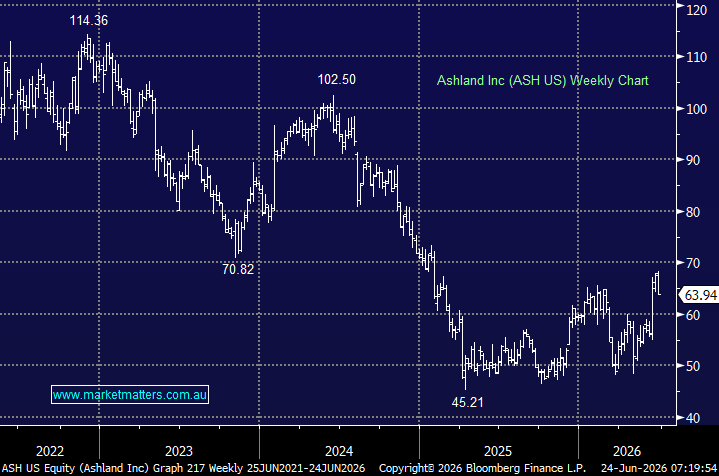
Ashland has had a difficult run over the past few years, so the recent share price strength on takeover speculation has been a welcome development for shareholders, including MM. While the stock has rallied sharply over the past few weeks, it still trades on 16x depressed earnings, suggesting the market remains sceptical of its ability to turn things around.
By way of refresher, Ashland is a US-listed specialty chemicals business. It produces additives and specialty ingredients used across pharmaceuticals, personal care, coatings, nutrition and industrial applications. These are not commodity chemicals in the traditional sense; Ashland’s products are generally higher-value inputs that help improve texture, stability, performance, delivery or functionality in customer products. In short, it owns good assets, but the market has been questioning whether those assets are being properly valued inside the current listed structure.
That is where the activist campaign becomes important. Cruiser Capital Advisors has now joined Ancora Alternatives in pushing Ashland to formally explore a sale of the company. The argument is relatively straightforward: Ashland has attractive assets, but it lacks the scale to maximise shareholder value as a standalone listed business. In Cruiser’s view, a strategic buyer or private equity owner could remove duplicated costs, reduce corporate overhead and extract at least US$100m of synergies.
For existing shareholders, this is a positive catalyst and it speaks to the embedded value we saw in the stock when buying it in February at ~$63. Ashland’s operating performance has been underwhelming, with the company reporting a 48% year-on-year decline in quarterly net income to US$16m for the March quarter; however, the activist pressure reframes the investment case. The question is no longer simply whether Ashland can grind out an internal earnings recovery (we think they can); it is now whether the board can unlock value through a strategic review, sale process or at least a more aggressive self-help plan.
Cruiser is applying real pressure. It has asked Ashland’s board to retain independent financial advisers, commence a review of strategic alternatives and run a competitive process involving both strategic buyers and private equity firms. Importantly, it has also flagged a potential proxy challenge if the board is not engaged in a credible sale process by 15 September.
Long-term investor Leon Cooperman, via Omega Advisors, owns around 1.7m shares, or roughly 3–4% of Ashland and has publicly backed Ashland’s board and management, but he has also said he is open to a potential sale process. That is an important distinction. It is not outright activist support, but it does suggest that even supportive shareholders want the board to assess all credible paths to value creation. For us, that is the right approach.
From our perspective, Ashland has often screened as an underappreciated business with a portfolio of quality specialty ingredients assets. The issue has been the absence of a clear catalyst and the market’s lack of confidence in the earnings trajectory in what should be a fairly defensive/predictable earnings stream. The recent activist pressure changes that equation. A sale is certainly not guaranteed, and the board may ultimately decide that the best outcome is to remain independent, but the pressure to demonstrate value is now far greater than it was a month ago.
We own Ashland in the International Equities Portfolio and will continue to hold the position. The recent rally has been encouraging, but with the stock still ~40% below its 2022 high of $US113, we do not think the market is overpaying for a takeover outcome at this stage. The key from here will be whether the board engages constructively, whether genuine buyers emerge, and whether management can show that the underlying earnings base is stabilising.