Skip to Content
scroll

Market Matters Q&A

Our Q&As are emailed in our Saturday morning Weekend Report, here’s a list for you to access them directly. If you have a question, we’d love to hear it. NB: Questions submitted prior to midday each Friday will be included.

* Questions for Saturday must be submitted before midday Friday.

Ask a question

You must be a logged in member to use the Market Matters Q&A

Not a member? You can take a free 14-day trial of Market Matters and get full access to all member benefits, including Q&A...

Take a free trial

Already had a free trial? Learn more about membership options

Membership options

Got a question for Market Matters about your membership or acount access?

Contact support

The Latest Q&A

Question asked

How exposed are Mirvac Group (ASX: MGR) to property weakness?

Hi MM,

I have heard concerns from more than one expert/commentator now (including in person), about the potential for upcoming housing market/property weakness (at least in relative terms), and how MGR (and SGP) are potentially more exposed to this than other REITS (and many other sectors).

Conversely, you have been quite bullish on MGR of late at current levels – including stating that they “should benefit from the budgets push for new home builds” and that you like the risk/reward at current levels.

Do you share to any degree the concerns by other commentators of the kind I have mentioned and remain bullish on MGR nonetheless? Do you disagree with these concerns or see them as already in the price? I am interested primarily in MGR but would also welcome your views on SGP.

Thanks,
Darren

Darren

Read more
Question asked

Thoughts on the Vanguard Australian Shares High Yield ETF (ASX: VHY)

Dear team,

A few weeks ago you spoke highly of ETF VHY and liked it at $83 or below. I have found very little research information on this outfit and notice it is not in your portfolio of ETFs or in your Active Income portfolio. I have an interest in this stock but wonder if you have more to add or if your opinion of it has changed. I like the dividend profile and that fact that it seems to have at least a little bit of growth potential. In these troubled times I am more cautious than usual so any additional comments or re-enforcement of existing statements would be very welcome.

Thank you to the whole team for your splendid general guidance. You may add sleep enhancement to your long list of achievements.

Paul

paul

Read more
Question asked

Reconciling Credit Corp (ASX: CCP) and Light and Wonder (ASX: LNW)

Hi

I appreciate that MM doesn’t have a specific ethical investing mandate for it’s portfolio’s but I was pleased to see the following comment about Credit Corp in last weekend’s Q &A:

“From our own perspective, we’re not that keen to buy a business like this, that relies of debt collection tactics that apply pressure to often vulnerable parts of society”.

But it made me wonder how MM reconciles that point of view with investing in a company like Light and Wonder (and potentially Aristocrat) which makes machines for gambling, which also has negative effects on vulnerable members of society (as shown on a programme currently screening on the ABC). Obviously they are different companies orperating in very different areas. Are there any red-line areas or companies that MM won’t invest in?

Cheers, Carl

Carl

Read more
Question asked

What would be highest conviction equity positioning

I follow your incisive newsletter every day and have found your analysis stimulating and informative. While you often focus on macro analysis, I feel it is very US focussed naturally, but the rising power of China is often missed.

I have been following Andre Jikh’s incisive analysis of geopolitics and the global monetary system, he makes some fascinating points. Recently he posted a detailed analysis across macro economics and finance and doesn’t believe that “Trump went to China to deliberately crash the dollar”. He believes in a broader hypothesis: the meeting may have been part of a larger effort to rebalance the global monetary order in a way that reduces pressure from U.S. debt dynamics. Jikh frames it as a possible modern version of the 1985 Plaza Accord — sometimes discussed in macro circles as a “Mar-a-Lago Accord” concept — where the U.S. would seek a controlled weakening of the dollar rather than allow an uncontrolled adjustment later. Variants of this theory have been discussed by market commentators and policy observers, though many aspects remain speculative rather than established policy.

His argument can be summarised in several linked ideas:

• The U.S. debt problem is becoming structurally harder to finance. Large and growing debt levels require continual Treasury demand. If interest costs keep rising, debt servicing itself becomes a larger fiscal burden.

• The reserve currency role creates both privilege and burden. The U.S. benefits because the world needs dollars and Treasuries, lowering borrowing costs and allowing persistent deficits. But global demand for dollars can also keep the dollar stronger than would otherwise occur, making exports less competitive and contributing to trade imbalances.

• A moderately weaker dollar could relieve pressure. A weaker dollar can:

make U.S. exports more competitive, reduce the real burden of nominal debt over time through inflation and currency depreciation, encourage domestic manufacturing and reshoring.
But this only works if the decline is gradual and trusted. A disorderly loss of confidence could instead raise Treasury yields and worsen debt costs. The larger geopolitical implication is where the analysis becomes more interesting. Reserve currencies are not just economic tools; they are geopolitical infrastructure. Dollar dominance allows the U.S. to:

Fund deficits more cheaply, impose sanctions with global reach, influence capital flows, shape trade settlement systems. Just look at what the demise of the pound as a reserve currency did to the British Empire in the 1950s.

Countries such as China have spent years trying to reduce dependence on this architecture through gold accumulation, bilateral trade settlement in local currencies, and yuan internationalisation efforts. Yet replacing the dollar is much harder than many narratives imply because reserve currencies depend heavily on deep capital markets, legal institutions, liquidity and trust. Even critics of U.S. policy note that there is currently no full-scale substitute.

The most useful takeaway from Jikh’s analysis may not be Trump wants a weaker dollar. The more important question is whether the U.S. is attempting to preserve dollar dominance by reshaping the rules before markets force a reshaping anyway.

Assume Andre Jikh’s thesis is directionally correct: that U.S. policymakers are intentionally seeking a controlled depreciation of the USD to manage debt sustainability and rebalance trade. What leading indicators over the next 12–24 months would confirm or invalidate this thesis? Specifically, which signals would you track across Treasury yields, term premium, DXY, foreign Treasury ownership, gold reserves, capital flows, and sector performance, and what would be the highest-conviction equity positioning if this scenario unfolds?

Nick

Read more
Question asked

AnteoTech Limited (ASX: ADO)

Thanks as always in advance gents:
So, you haven’t covered this company for some time – and a while ago you warned me off it for good reason – but tiny AnteoTech (ASX:ADO), given their recent announcement, seem to have enormous new markets open to them.
The share price skyrocketed on the news, so what might you consider to be a 12-month target price now (understanding that these small companies do spike briefly on any positive news)?
PS – this is only Monday, so we’ll see what the week brings.

David

Read more
Question asked

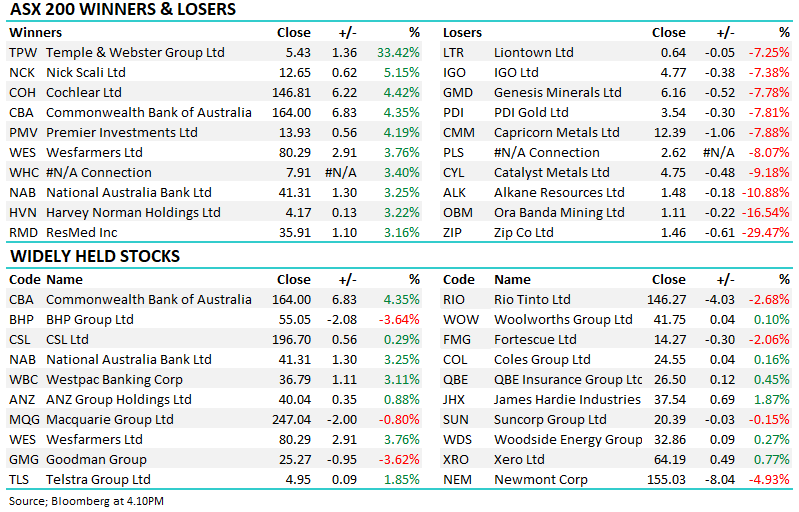
Woodside Energy (ASX: WDS) v Santos Ltd (ASX: STO)

Hi MM team, great service and I m a very happy investor as a result, can I ask a boring, procedural question please.

Can you please revert to quoting Woodside daily price action in your end of day report as I feel Santos is more about corporate plays and a smaller energy player than the larger big daddy international oil and gas player, yes, I am an investor in Woodside, maybe bias. Have a great week, also hopefully the Maroons have won the 1st state of origin by time of publishing your weekend report, Cheers Steve K

Steve

Read more
Question asked

Thoughts on the VanEck Australian Subordinated Debt ETF (ASX: SUBD) for income

Hi,
Thanks as always for your valuable insights. I note you haven’t covered the SUBD ETF In a while. Any thoughts on it as a consistent income generator?
Thanks
Michael

Michael

Read more
Question asked

BetaShares Nasdaq 100 ETF (ASX: NDQ) and SpaceX inclusion

Hi guys,

It is my understanding that the Nasdaq in recent weeks made amendments to the rules for the Nasdaq 100 index to “fact track” SpaceX entry on to the index.

How and when would an ETF like NDQ reflect such an inclusion?

SpaceX free float is actually very low (I believe no more than 8%), but the market cap is large (money wise). Is there a risk of funds having to rotate from other sectors/stocks to cover the weight of SpaceX in the index?

Lastly, I read your response about Pengana Private Equity Trust as a vehicle to gain exposure to the IPO. It appears to me that the recent share price appreciation is driven by SpaceX interest as the rest of the investments are a bit of a black box. It seems very speculative and prone to dilution post IPO, in my humble opinion. What do you think?

Thanks for your responses.
Angela

What is MM advice regarding SpaceX IPO? Should we be attempting to join the chorus of interest in buying shares directly? Or maybe we can buy into a fund or ETF that contains SpaceX holding. Or just stay out of it!

Sandy


Angela

Read more
Question asked

Catapult Sports Ltd (ASX: CAT)

Hi team, you are doing an excellent job in helping us navigate the stock market.

I would like your thoughts on CAT. CAT announced FY26 results on 20/5; the stock was up 17% on that date, closing at $3.39, and reached a high of $3.885 on the next day (21/5).

CAT was down 6.16% today (25/5), closing at $3.35.

Do you know the reason for today’s big fall?

Peter

Read more
Question asked

Similarities to 1929?

Hi

I’m currently reading a book about the stock market crash of 1929 and a lot of the circumstances back then seem eerily similar to what’s going on today, at least in the US market – tons of money looking for somewhere to be placed (lots of it borrowed), almost daily rises in the markets, an endless belief that the markets can only go up, most of the increase concentrated in a few stocks / industries (AI is the obvious current example) etc.

Is there any reason we couldn’t be heading for something similar, at least in the US, which would presumably spread to other markets around the world?

I’m not wishing for it to happen – far from it – but things seems to be repeating themselves, especially in tech / AI.

Cheers, Carl

Carl

Read more
more
image description

Relevant suggested news and content from the site

Back to top