Hi Steve,
We think you’re on the money with this assessment. At MM, we believe the AI trade is broadening rather than ending, with the next major opportunity likely to come from businesses that can translate AI-driven productivity improvements into tangible earnings growth.
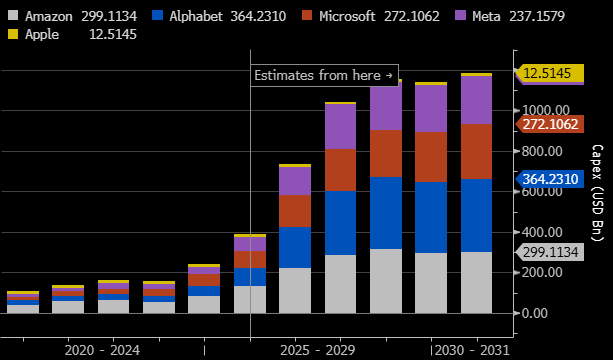
The scale of the AI investment boom is extraordinary. Capital expenditure across the major US technology giants has risen from around US$100bn in 2020 to more than US$400bn in 2025, with spending expected to accelerate significantly again in 2026. Goldman Sachs estimates global AI-related investment will exceed US$1 trillion this year alone.
These businesses are spending heavily because demand for computing capacity continues to grow, and they expect that demand to be enduring. When customers want more of what you’re selling, it makes sense to invest in additional capacity. Of course, the risk is that supply eventually catches up with demand, putting pressure on pricing and returns on capital. However, we don’t believe we’re at that point yet.
What has changed is the market’s willingness to fund this investment without questioning the returns. Rising capital expenditure, greater reliance on debt financing and elevated valuations are making investors increasingly sensitive to any suggestion that returns might disappoint. We don’t think the AI infrastructure trade is dead, but it’s certainly got the wobbles!
More broadly, we agree that investor attention is starting to shift from those building AI infrastructure towards businesses that can demonstrate genuine productivity gains from adopting the technology. Goldman Sachs has identified AI platforms and productivity beneficiaries as the next phases of the investment cycle, which makes sense to us.
- We believe AI will benefit the vast majority of businesses to varying degrees, potentially making productivity improvements one of the defining investment themes of the next decade.
The most attractive beneficiaries, in our view, are established businesses with large labour costs, valuable proprietary data and sufficient pricing power to retain the savings rather than pass them on to customers.
On the ASX, we see plenty of opportunities across traditional, or ‘old world’, industries:
- Banks (CBA, NAB, WBC, ANZ): Significant potential to reduce costs across customer service, compliance, fraud detection and back-office processing. In high-volume businesses, even relatively modest efficiency improvements can have a meaningful earnings impact.
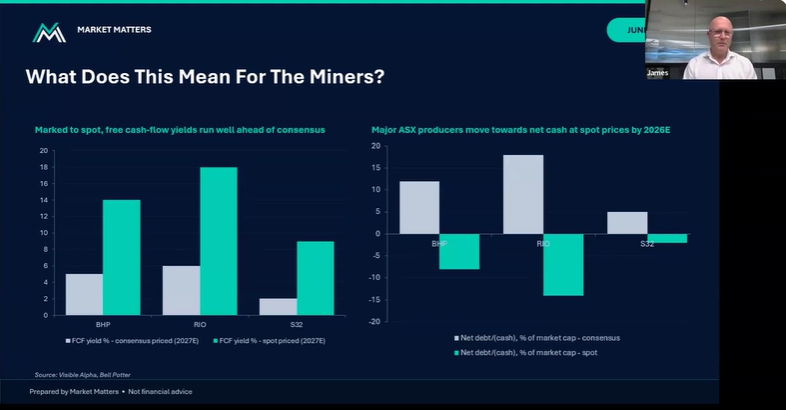
- Miners (BHP, RIO): AI-driven improvements in mine planning, autonomous operations, equipment maintenance and processing efficiency could deliver meaningful productivity gains.
- Telcos (TLS): Large customer service operations, extensive networks and significant operating costs provide plenty of scope for automation and efficiency improvements.
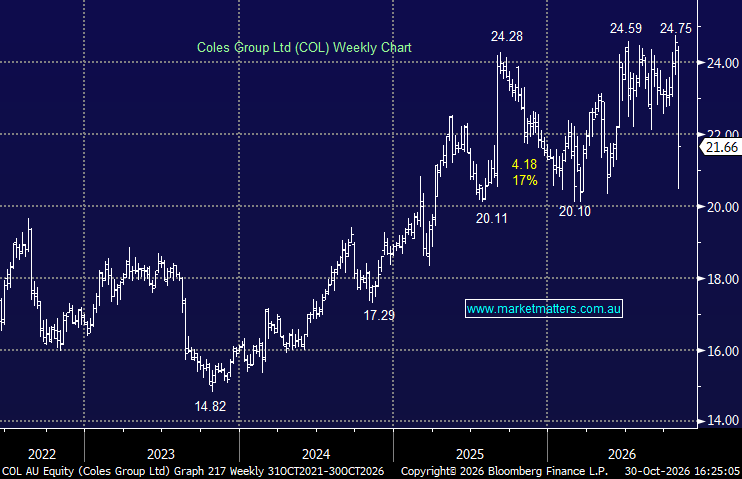
- Retailers (WOW, COL, WES): AI can improve inventory management, demand forecasting, logistics and customer engagement, potentially reducing costs and improving margins.
Importantly, not every company will retain these benefits. In highly competitive industries, productivity improvements may ultimately be passed through to customers in the form of lower prices. AI will also disrupt existing business models, as we’re already seeing with some ASX-listed software companies.
The other challenge is quantifying the earnings upside. While the potential productivity gains are enormous, investors will increasingly want to see evidence of those savings flowing through to the bottom line, rather than simply hearing management talk about AI opportunities.
Our view at MM is that the AI trade is evolving, not ending. We remain positive on the longer-term infrastructure opportunity, but increasingly see merit in looking beyond the obvious technology winners towards established businesses capable of using AI to improve margins, productivity and ultimately shareholder returns.
The next leg of the AI trade may be less about who spends the most on the technology, and more about who makes the most money from using it.