Hi Nick,
KIT is more of a private-credit and structured-finance vehicle than a conventional bond LIT. You can get more detail on their actual underlying holdings from their most recent update in August, and this shows significant exposure to private credit and structured lending, with 52% invested in warehouse financing, predominantly backed by residential mortgages (34%), automotive loans (8.5%), consumer lending (7.4%) and medical lending (2.1%). Beyond this, the portfolio comprises senior unsecured debt (17.2%), asset-backed securities (9.6%), Lower Tier 2 debt (5.9%), mortgage-backed securities (4.6%) and senior secured debt (3.3%), with the balance held in cash and other exposures.
Importantly, KIT carries meaningful exposure to subordinated credit, with 30.1% of the portfolio invested in mezzanine debt and a further 28.1% in junior debt, compared with just 41.1% in senior-ranking securities. This means a substantial portion of the portfolio sits lower in the capital structure and is more exposed to losses if underlying credit conditions deteriorate.
From a credit-quality perspective, the portfolio has an average BBB rating, although approximately 32% of securities are either below investment grade or unrated. The portfolio generates a yield to maturity of approximately 9.2%, with 83% invested in floating-rate securities, limiting interest-rate sensitivity. However, this does little to protect against deteriorating credit quality.
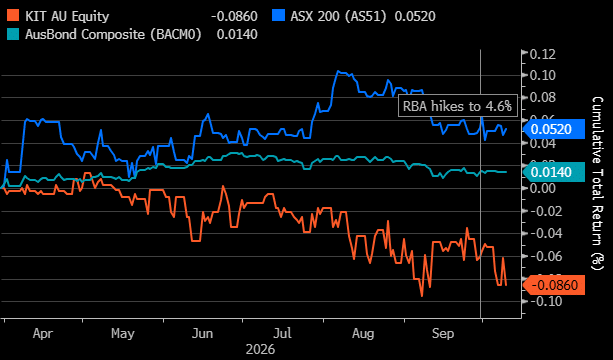
We think the weakness and subsequent 13% discount KIT is trading at relative to NTA is partly a reflection of what’s playing out at Metrics which we covered on Friday here. There is increasing scrutiny on the valuation of private credit assets, and we think this will flow through the sector more broadly, but at $1.75 KIT has already priced these risks, in our view.
Overall, we regard KIT as a relatively high-risk credit investment, particularly given its concentration in warehouse financing and significant exposure to mezzanine and junior debt, but the yield on offer we think is providing adequate compensation.