Hi Scott,
This is an area we haven’t spent much time on in the past hence for reference:
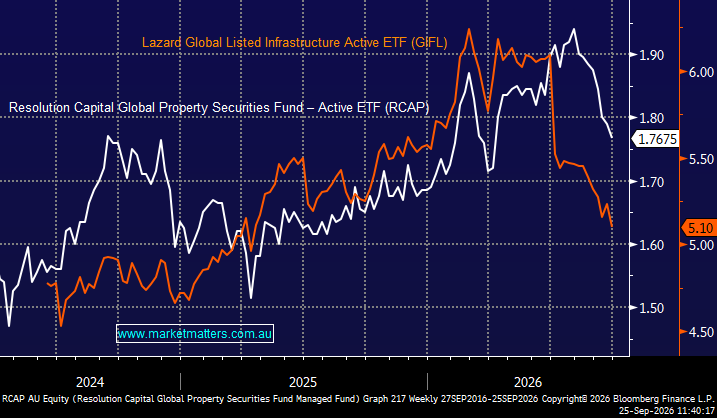
RCAP – Resolution Capital Global Property Securities Fund (Active ETF): An actively managed ETF providing exposure to global listed property companies and REITs, including sectors such as data centres, logistics, residential, retail and healthcare property. Its performance is typically influenced by property fundamentals, interest rates and global economic conditions.
- Globally it has 68% in the US, followed by 7% in Japan and 5% in the UK, for the diversified exposure the cost is 0.8% pa.
- YTD the fund is up +5.1% trumping the ASX 200’s +3.2% – both including dividends.
Similarly, the REIT ETF gives broad global REIT exposure (US-heavy, +70%) at less than half RCAP’s fee – both hedged. Its performance is better than the more expensive active ETF at +6.1% outperforming the RCAP ETF.
GIFL – Lazard Global Listed Infrastructure Active ETF: An actively managed ETF investing in global listed infrastructure companies, including electricity networks, toll roads and other essential assets. It aims to provide relatively defensive earnings and income supported by the predictable cash flows of infrastructure businesses.
- Its top ten (~70% of the fund) is held across six countries, sector split is primarily Utilities ~50% & Industrials ~40%, with an OECD-focused mandate, with a cost of 0.98%.
- YTD the fund is up +0.01% underperforming the ASX 200’s +3.2% – both including dividends.
There are alternatives available in the two spaces: IFRA and GLIN both track essentially the same passive exposure at a fifth of GIFL’s cost – all 3 hedged. YTD the IFRA is +4.6% and the GLIN +4.91% suggesting that the actively managed GIFL isn’t currently warranting its mgt. fee. – we like and hold the IFRA in our Core ETF Portfolio.
In both cases we prefer the passive ETFs to their more active peers.