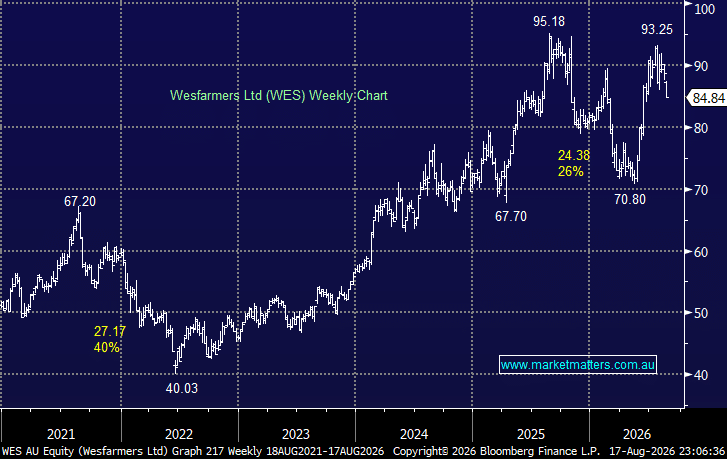
WES has been the pin up in the consumer discretionary space, although it does have broader exposure outside of retail. The owner of Bunnings reports FY26 results on the 27th of August, and there looks to be a lot of optimism already baked into the price.
Positives
- WES is regarded as top quality often defensive retailer on the ASX.
- Its diversified group structure, outside of Bunnings, (Kmart, Officeworks, Health, WesCEF), provides a meaningful buffer to a contracting housing market.
- A partial offset to housing weakness/stagnation is: Bunnings’ DIY segment is more resilient than its trade/commercial segment in a downturn, as homeowners who cannot sell or upgrade tend to renovate instead.
- The stock is +5.2% year-to-date, outperforming the sector – as we often say, don’t fight the trend.
Negatives
- The stock is trading ~10% above its long-term valuation.
- Bunnings generates approximately 60% of Wesfarmers’ group EBIT, making it by far the group’s largest earnings driver and its key exposure to the Australian housing cycle.
- Construction costs add another headwind: Higher oil prices following the US-Iran conflict are pushing up the cost of key building materials, further squeezing housing affordability and new construction—another drag on Bunnings’ trade business.
- Sentiment is likely to remain subdued until the company reports.
If WES can report solidly later this month – which they tend to do, we can see WES holding its premium over the broader sector, but we would not be chasing the stocks here and if we owned it, we’d certainly be trimming it.
- We believe WES is susceptible to some profit taking given it’s elevated valuation.
MM is neutral towards WES around $84
Add To Hit List