Hi Michael,
Thanks for your ongoing support, much appreciated.
There are a few options here:
US-listed which by definition come with currency risk as your holding a US$ ETF:
- Invesco S&P 500 Equal Weight ETF (NYSE: RSP) — the original and largest; each of the 500 constituents equal-weighted at ~0.2%, rebalanced quarterly. Expense ratio ~0.20%.
ASX-listed:
- BetaShares S&P 500 Equal Weight ETF (ASX: QUS) — unhedged, ~$1.34bn FUM, tracks S&P 500 Equal Weight – Expense ratio ~0.29%.
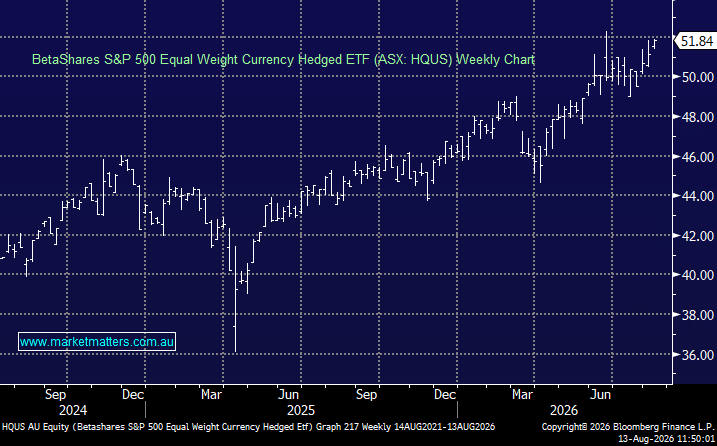
- BetaShares S&P 500 Equal Weight Currency Hedged ETF (ASX: HQUS) — same exposure, AUD-hedged – Expense ratio ~0.32%.
It’s important to note the Invesco S&P 500 Equal Weight ETF (NYSE: RSP) has outperformed SPY by nearly 5 percentage points YTD in 2026, benefiting from its lower exposure to the mega-cap tech names that have weighed on the cap-weighted index. Conversely the trade-off is that equal weighting introduces a meaningful mid-cap and cyclical tilt, with greater exposure to financials and industrials. As a result, RSP can behave very differently from SPY during tech-led markets, most notably underperforming sharply through 2023–24 as mega-cap growth dominated returns.
- MM’s pick of the above is the HQUS as we’re bullish towards the A$ dollar.
As for the Global X Nasdaq 100 Covered Call ETF (NASDAQ: QLYD), a buy-write income fund on the Nasdaq-100 that buys the stocks in the Nasdaq 100 Index and writes call options on the same index, yielding a high monthly distribution (~11-13%) in exchange for capped upside, it all comes down to performance.
- The ETF has underperformed the S&P 50 over the last 3 and 5-years so it’s not surprising were not keen plus it costs 0.6% pa.