This week, we sent a note to Members and Investors on the importance of monitoring fundamental trends within company earnings, and why MM intends to place greater weight on this measure within our investment process.
Absolute earnings still matter, but increasingly, it is earnings momentum – the rate and direction of change in expectations – that drives share-price performance. A company can remain highly profitable, trade on a reasonable valuation and continue to grow, yet still underperform if revenue growth, margins or forward earnings expectations are being revised lower.
This is likely being amplified by the growth of quantitative and systematic investment strategies, which often respond more aggressively to changes in earnings revisions, price momentum and analyst expectations than to absolute valuation. In this environment, the “second derivative” matters: not simply whether a company is growing, but whether that growth is accelerating or slowing.
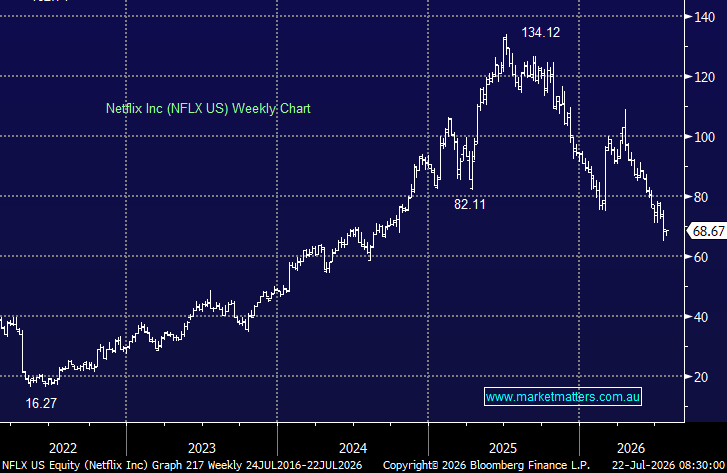
Netflix (NFLX US) is a good example. Netflix is a global brand with enormous scale, a difficult-to-replicate platform and a highly profitable business model. The shares now trade on a valuation around 40% below their historical average, yet the stock remains under significant pressure because the rate of growth is slowing.
- Revenue increased by 17.6% in the final quarter of 2025, 16.2% in Q1 2026 and 13.4% in Q2, while Q3 guidance implies growth of around 11.7%.
That remains respectable, but the direction matters. Subscriber penetration is already high across mature markets, leaving Netflix increasingly reliant on price increases, advertising, live content and stronger monetisation of its existing customer base to sustain growth. We are also uncomfortable with the reduction in operating disclosure. Netflix no longer places the same emphasis on subscriber numbers and plans to publish viewing data less frequently. Management argues that revenue and margins are now more relevant measures, which is understandable, but markets naturally become more cautious when operating metrics are removed at the same time growth is slowing.
Advertising remains a promising opportunity, but it is not yet large enough to materially transform the earnings profile. Even at around US$3bn this year, advertising would account for less than 6% of group revenue. Content is another consideration. Netflix benefited from a particularly strong slate in 2025, while 2026 has so far lacked the same concentration of major global hits. The company must continue spending heavily on content to maintain engagement, limit subscriber churn and preserve pricing power.
Importantly, consensus forecasts still point to an attractive earnings profile. EPS is expected to rise from approximately US$3.53 in 2026 to US$5.41 in 2029, implying mid-teens annual earnings growth, supported by margin expansion and strong cash generation. This helps explain why analysts remain bullish. Around 77% still rate Netflix a buy, while the consensus price target is close to US$99, almost 50% above the current share price.
So why the disconnect?
Following our annual review of portfolio performance, with a clear focus on where we can improve, one common feature stood out among stocks that experienced material de-ratings. In many cases, the valuation still appeared reasonable relative to current earnings. However, even modest reductions in forward guidance or consensus expectations triggered sharp exits from momentum-sensitive capital.
This theme is evident across global markets. Traditional value investors may be attracted to a lower valuation, but they can be overwhelmed in the short term by systematic, momentum and earnings-revision strategies responding to deteriorating trends. Benchmark-aware and passive flows can then amplify the move as falling share prices reduce index weights, attract less incremental capital and weaken technical support.
We do not own Netflix. On a valuation anchored to absolute earnings, the shares look increasingly attractive. However, until we see an inflection in revenue growth, earnings revisions or forward expectations, we are unlikely to buy the stock.
Netflix remains a very good business trading on a more reasonable valuation. But in the current market, being good and reasonably priced is not always enough. The earnings trend also needs to stop deteriorating.
- The broader lesson is that valuation tells us what is priced in, while earnings momentum often determines when the market is prepared to recognise that value.
MM is neutral on NFLX US ~$US68
Add To Hit List